What a calming facial involves, who it suits, which ingredients and steps to look for, what to avoid, and how to care for your skin afterward.
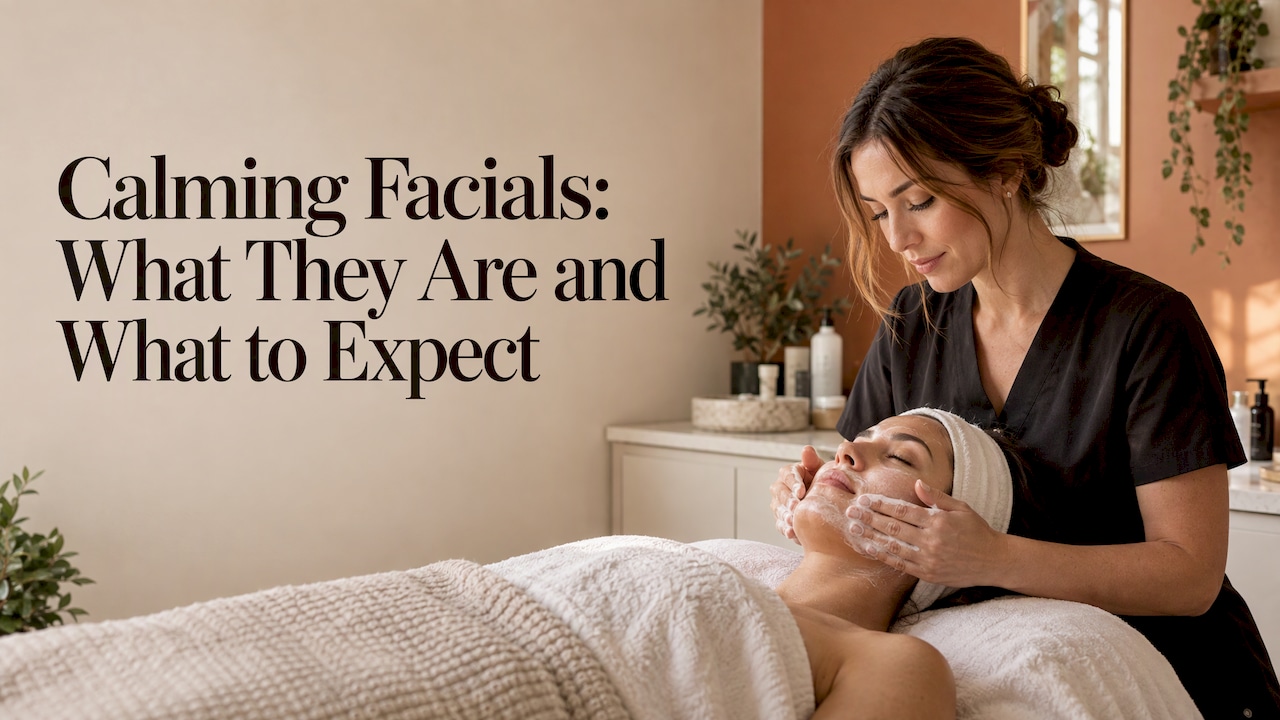
A calming facial is a facial built around gentleness. It uses soothing ingredients, light massage and no harsh exfoliation, so reactive, flushed or stressed skin can settle while you relax. If your skin stings, turns red easily or just feels overworked, this is the kind of treatment to ask your esthetician about. Below you will find what happens in the treatment room, what belongs in a soothing protocol, what to avoid, and how to look after your skin afterward.
TL;DR
- A calming (or soothing) facial is a customized facial that favors gentle cleansing, anti-inflammatory ingredients and soft massage over aggressive exfoliation.
- It suits skin that feels sensitive, looks red or reacts easily, and anyone who wants a quiet, restorative hour.
- Ask about steam, strong acids, fragrance and scrubs before you book, and tell your esthetician about any skin condition.
- Afterward, keep it simple: a mild cleanser, a barrier-supporting moisturizer and a mineral sunscreen.
- At Silver Palm in Littleton, our Signature Custom Facial is tailored to your skin on the day you come in.
Table of Contents
- What a calming facial is
- Who a calming facial is for
- What happens during a calming facial
- Ingredients that belong in a soothing facial
- What to avoid on reactive skin
- What a calming facial costs
- How to choose the right facial
- Perspective: why we build facials around your skin that day
- Book a facial at Silver Palm
- Caring for your skin after a facial
- How often to book
- Calming facial or something stronger?
- FAQ
- Sources
What a calming facial is
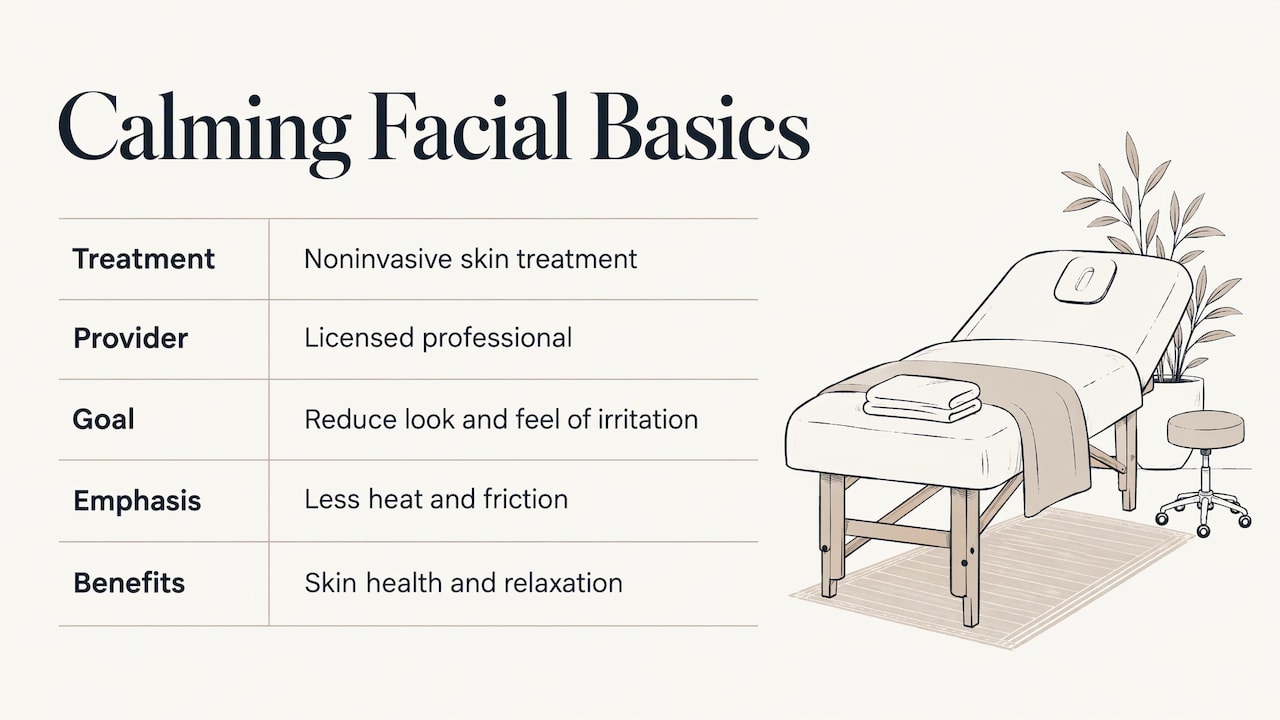
A facial, as Cleveland Clinic describes it, is a noninvasive skin treatment that combines cleansing, moisturizing, exfoliating and other steps, customized to your skin type and needs. It is performed by a licensed professional such as an esthetician, and it is meant to address skin concerns, support overall skin health and help you relax.
A calming facial keeps that framework and changes the emphasis. The goal is to reduce the look and feel of irritation rather than to resurface the skin. You will see it called a soothing facial, a sensitive-skin facial, an anti-redness facial or a relaxation facial. The names vary from spa to spa, and what matters is what is actually done to your skin: which products, how much heat, how much friction.
That is why a calming facial is as much about restraint as about additions. A good one removes the steps that could provoke a reactive complexion and keeps the ones that comfort it.
Who a calming facial is for
Sensitive skin is common. A scoping review in the Journal of Drugs in Dermatology reports that it affects roughly 40 to 50 percent of the population. It describes sensitive skin as a subjective syndrome of hyperreactivity to otherwise harmless stimuli, showing up as dryness, easy irritation, redness, itching, burning, tightness or stinging.
A calming facial may be a good fit if you:
- notice stinging or tightness after using new products
- flush easily or have visible redness
- feel your skin is dry, dull and irritated after a harsh season or a stretch of over-exfoliating
- want a facial primarily for the relaxation, with skin comfort as the bonus
- are stressed and want an hour that slows everything down
Stress deserves a mention. Medical News Today notes that the relaxation a facial provides can help ease stress, which is a common trigger for rosacea flare-ups. That does not make a facial a medical treatment, but it explains why many people book one when life is hectic.
When to see a dermatologist first
If your skin burns, itches or flares constantly, start with a medical opinion. The same Journal of Drugs in Dermatology review advises that patients presenting with sensitive skin stop all topical products for two weeks and then have a dermatologic evaluation. If sensitive skin is still suspected, products are reintroduced gradually to identify triggers. A facial works best after you know what your skin reacts to.
If you have diagnosed rosacea, eczema or psoriasis, tell your esthetician before the appointment. Medical News Today stresses working with a qualified esthetician or a dermatologist experienced with rosacea, because aggressive techniques and harsh products can make symptoms worse.
What happens during a calming facial
Every spa sets its own protocol, but a soothing treatment generally moves through these stages.
- Conversation. Your esthetician asks about your skin history, products, medications, recent treatments and what has been bothering you. This is the moment to mention reactions, allergies and conditions.
- Gentle cleansing. A mild cleanser is applied with light pressure and removed with lukewarm, not hot, water or cloths.
- Analysis. Your esthetician looks at the skin’s condition that day, since reactivity changes with weather, stress and your routine.
- Soothing treatment. Calming ingredients go on, often with light massage. UPMC notes that calming facials for reactive skin use ingredients such as oatmeal, green tea or cucumber extract to reduce redness and irritation, while avoiding harsh exfoliants and relying on gentle massage.
- Mask and moisture. A hydrating or comforting mask follows, then a moisturizer.
- Protection and aftercare advice. Sunscreen and a short list of dos and don’ts for the next few days.
Massage can play a real role. Skin Inc. quotes an esthetician who says that increasing circulation is one of the best things you can do for skin that looks sensitive, and describes a sensitive-skin protocol that incorporates lymphatic detox massage. Note that this is one professional’s approach, and it is a light, rhythmic touch rather than deep pressure.
Ingredients that belong in a soothing facial
Medical News Today lists the calming, anti-inflammatory ingredients found in rosacea-friendly facials: chamomile, aloe vera, green tea extract, niacinamide and colloidal oatmeal. UPMC adds cucumber extract to the list of ingredients used on reactive skin.
For moisture, the dermatology review recommends moisturizers for sensitive skin that combine humectants such as glycerin, hyaluronic acid and aloe vera with emollients such as ceramides and plant oils. It also says formulations should be fragrance-free, hypoallergenic and non-irritating.
One caution from that review is worth knowing: there is currently no federal or legal standard regulating ingredients in products marketed for sensitive skin, and many have not been tested in sensitive skin specifically. A “for sensitive skin” label is therefore not a guarantee. Ask what is in the products used on you and read the ingredient list of anything you take home.
What to avoid on reactive skin
A calming facial is defined as much by what is left out. Sources agree on a fairly consistent list.
| Avoid | Why it matters | Source |
|---|---|---|
| Abrasive scrubs and fruit-pit scrubs | Friction and tiny tears can inflame reactive skin | Skin Inc., Medical News Today |
| Strong acid peels and microdermabrasion | Can strip and irritate a sensitive barrier | Skin Inc., Medical News Today |
| Heavy steam, hot towels, excessive heat | Heat can provoke flushing | Skin Inc., Medical News Today |
| Heavy fragrance, alcohol, menthol | Common irritants in skin care | American Academy of Dermatology |
| Camphor, sodium lauryl sulfate, urea, glycolic and lactic acids | Listed by the AAD for people with rosacea | AAD |
The AAD also advises choosing fragrance-free rather than merely “unscented” products, since unscented items can still contain masking fragrance. If scent sensitivity is part of your story, this guide to choosing perfume for sensitive skin is useful for the products you wear every day, not just the ones used in the treatment room.
UPMC describes how facials go wrong in general: over-exfoliation that damages the skin barrier, poorly done extractions that lead to inflammation or scarring, infection from tools that are not properly cleaned, and reactions to strong ingredients or fragrances. Its advice is to choose a licensed provider, share your skin history and follow pre- and post-care instructions. The risk rises when an esthetician is not trained to recognize underlying conditions or adjust the protocol.
Patch testing
If you have a history of reactions, rosacea, eczema, psoriasis or known allergies, SELF reports that dermatologists consider patch testing especially important before using new products. Ask your esthetician whether a patch test is sensible before a new product goes on your face, and do the same at home with anything you buy.
Add-on treatments and light therapy
Many spas pair facials with LED or light-based add-ons. If you are considering one, read up on red light therapy precautions and tell your esthetician about medications, photosensitivity or skin conditions first, so the add-on suits your skin that day.
What a calming facial costs
Prices differ by region, spa and protocol. For a benchmark, Skin Inc. reported in 2019 that a sensitive-skin facial in New York City cost $145 for 60 minutes, and a comparable anti-redness facial in Knoxville, Tennessee cost $120. Those are 2019 figures from other cities, so treat them as a rough range rather than a current quote. Silver Palm does not publish facial prices online, so contact us or check our facials page and ask what your treatment will include and cost before you book.
How to choose the right facial
The label matters less than the conversation. These questions help you judge whether a facial will be calming in practice:
- Is the treatment customized to my skin on the day, or is it a fixed routine?
- Which exfoliation, if any, will be used, and can it be skipped?
- Will there be steam or heated towels?
- Are the products fragrance-free, and can I see the ingredient list?
- Is my esthetician licensed, and do they know how to adjust for rosacea, eczema or other conditions?
The last point echoes the research: a licensed provider who understands your history is the main safeguard. If dryness rather than redness is your main concern, our guide to a facial for dehydrated skin covers what to expect, and our article on facials for Colorado’s dry climate explains why altitude and low humidity are hard on the skin barrier. For a wider look at options, see facials in Denver and how to choose.
Perspective: why we build facials around your skin that day
At Silver Palm, we think the most soothing thing a facial can do is listen. Skin changes with the seasons, with stress, with Colorado’s dry air, and a routine that worked last month may not suit you today.
That is the reason we offer a Signature Custom Facial rather than a one-size-fits-all protocol. We start with a conversation about how your skin feels and what you want from the hour, then shape the treatment around the answer. For some clients that means comfort and quiet. For others it means more targeted work on texture or dryness.
We also believe the setting is part of the treatment. A calm, upscale room, unhurried attention and a team that remembers your preferences are what turn a facial into real self-care. If you are unsure what your skin needs, tell us how it has been feeling and we will help you decide.
Silver
Book a facial at Silver Palm
Our Littleton spa offers the Signature Custom Facial and the DermaSweep Facial, along with massage, nails, hair services and medspa treatments. If you want a facial that feels restorative and is shaped around your skin, start with our Littleton facials page. Mention any sensitivity, skin condition or product reaction when you book, so your esthetician can plan the visit accordingly.
Caring for your skin after a facial
The hours and days after a calming facial are when you protect what the treatment did. The guidance from dermatology sources is refreshingly simple.
Keep the routine minimal
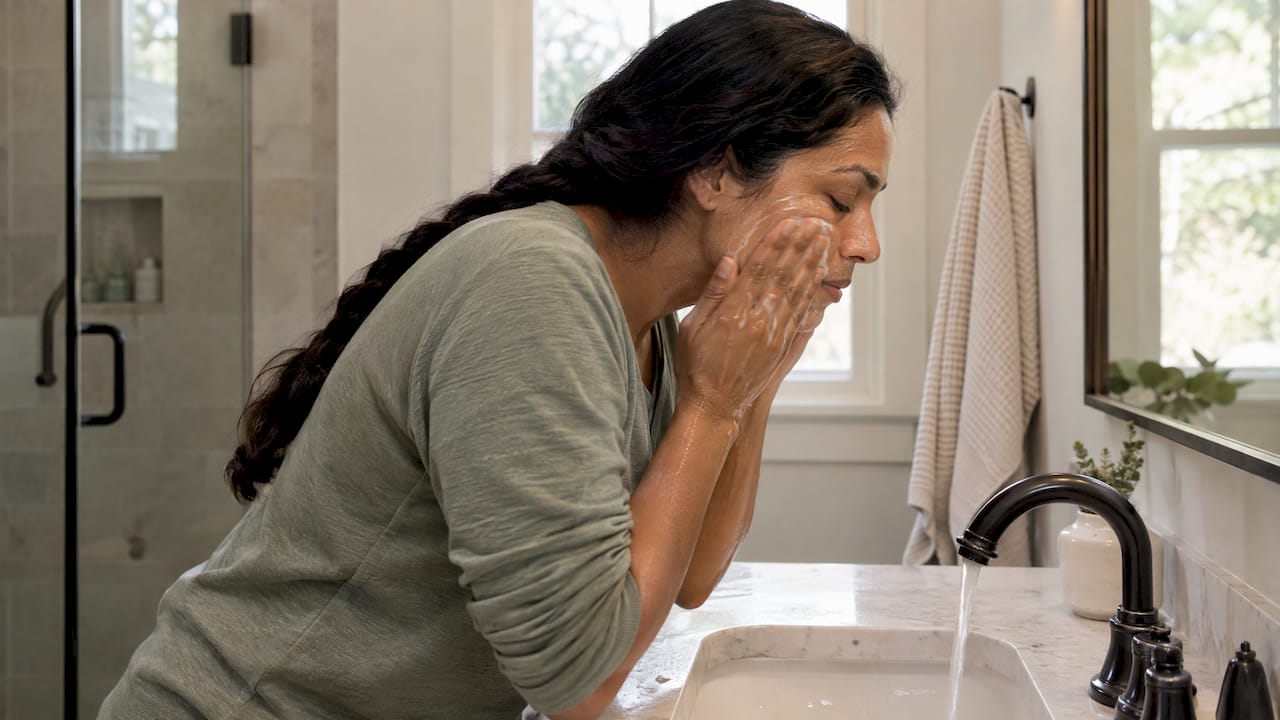
The dermatology review describes the foundation of a sensitive-skin routine as a mild cleanser, a moisturizer and sun protection. Cleansers should have a pH near that of skin and contain emollients. The AAD adds that people with rosacea should wash twice a day with fingertips in a circular motion, rinse with warm water and pat dry with a clean cotton towel, with no rubbing, scrubbing or massaging.
Moisturize with purpose
The AAD says moisturizing matters whether skin runs dry or oily. It also notes that applying a rosacea-friendly moisturizer or barrier repair cream can improve the results of treatment, citing a small study in which, after 15 days, the moisturized side of the face had less dryness, peeling and roughness. Look for humectants and emollients, and skip fragrance.
Wear sunscreen every day
Both sources recommend broad-spectrum sunscreen of SPF 30 or higher. The dermatology review prefers inorganic filters, titanium dioxide and zinc oxide, because they have lower allergenic potential. The AAD likewise suggests a fragrance-free mineral sunscreen if a chemical formula irritates your skin.
Pause the strong actives
Skin Inc. quotes an esthetician who says that when the skin barrier is compromised, you should temporarily cut back on anything that strips its natural protection, including strong topicals, exfoliating acids, mechanical exfoliators and harsh scrubs. Ask your esthetician when it is reasonable to restart retinoids or acids.
How often to book
There is no universal schedule. One esthetician quoted by Skin Inc. recommends her sensitive-skin facial every four weeks alongside a homecare routine, which is one professional’s view rather than a rule. A practical approach is to book a first visit, see how your skin responds over the following week and then agree on a rhythm with your esthetician. Many people time a calming facial before events, after travel, or at the change of seasons.
Calming facial or something stronger?
A soothing facial is not the only way to treat skin, and it is not meant to be. Textural concerns, fine lines, pigmentation or acne scarring may call for other treatments, and a medspa consultation can sort out the options. If you are curious, our team can talk you through them at our medspa in Littleton. Many clients alternate: a calming facial to restore comfort and hydration, then a more active treatment when the skin is steady.
FAQ
What is the difference between a calming facial and a regular facial?
Both cleanse, moisturize and customize to your skin. A calming facial leans toward gentle products and light massage, and it leaves out harsh exfoliation, strong acids and heavy heat. A regular facial may include more active steps such as extractions or exfoliating treatments.
Can a calming facial help with redness?
It can help reduce the look and feel of irritation by using anti-inflammatory ingredients such as aloe vera, chamomile, green tea and niacinamide. Persistent redness can have medical causes such as rosacea, so see a dermatologist for a diagnosis and tell your esthetician about it.
How long does a calming facial take?
Many spas schedule facials for about an hour. The two examples in the Skin Inc. article, both sensitive-skin facials, were 60 minutes. Ask us about the length of your specific treatment when you book.
What should I do before a calming facial?
Share your skin history, products and any reactions or conditions when you book and again at the start of the visit. Follow any pre-care instructions you are given, and ask about a patch test if you have reacted to products before.
Can I wear makeup or perfume afterward?
It is wise to go light for the first day, since your skin may be more reactive than usual. If you do, choose fragrance-free products and mineral sunscreen, and ask your esthetician what they recommend for your skin.
Sources
- Facials: What Are They, and What Do They Really Do? (Cleveland Clinic)
- Practical Approaches to the Diagnosis and Management of Sensitive Skin (Journal of Drugs in Dermatology)
- Facials for rosacea: Benefits, risks, and more (Medical News Today)
- Do Facials Really Help Your Skin? (UPMC)
- Expert Advice for Catering to Clients with Sensitive Skin (Skin Inc.)
- 7 rosacea skin care tips dermatologists recommend (American Academy of Dermatology)
- How to Patch Test Skin Care Products at Home (SELF)
- Perfume for Sensitive Skin: How to Choose and Wear It
- Red Light Therapy Safety: Risks, Side Effects and Precautions