How to find the best salon to work for: compare commission, hourly, booth rental and full-service luxury salon models on pay, training, culture and growth.
The best salon to work for is the one whose pay model, training, clientele and culture fit the stage of career you are in. For most stylists that means a full-service salon and spa with a steady stream of clients, a team that works together and room to add skills, rather than the loudest recruitment ad. This guide compares the main kinds of salon workplaces, shows what to ask at every one, and explains why a luxury, full-service salon and spa such as Silver Palm in Littleton, Colorado, is the kind of environment worth building a career around.
Key Takeaways
- Compare salons by type first: commission, hourly, hybrid, booth or suite rental, and full-service salon and spa each pay and support you differently.
- Pay is only one line. Training, benefits, how bookings reach you and how long the current team has stayed matter just as much.
- National wage figures are a baseline: the median hourly wage for hairdressers, hairstylists and cosmetologists was $16.95 in May 2024, and tips and commission can move your real income well above or below it.
- A salon that offers hair, skin, nails and medspa under one roof gives you a bigger pool of clients to draw from and more ways to grow.
- Judge culture with your own eyes: how the phone is answered, how the team talks to each other and how long people stay.
Table of Contents
- What “Best” Means for a Stylist
- The Main Types of Salon Workplace Compared
- What the Money Looks Like
- Questions to Ask Before You Accept
- How to Read a Salon’s Culture Before You Join
- Licensing: What You Need Before Any Salon Hires You
- Why a Full-Service Salon and Spa Is the Strongest Place to Build a Career
- Perspective
- Red Flags and Green Flags at a Glance
- A Simple Way to Decide
- Experience Silver Palm for Yourself
- FAQ
- Sources
What “Best” Means for a Stylist
There is no single best salon. A new graduate needs structured education and a full book handed to them. A stylist with ten years behind the chair needs autonomy, a clientele that pays for premium services and a team that respects their time. Someone moving to a new city needs a place that will fill their calendar quickly.
A useful frame comes from Modern Salon, which advises stylists to look for a supportive “work home” and to assess training, compensation and benefits, culture, how you are handled on the phone and how the team works together. That gives you five criteria to score every option against:
- Compensation: how you are paid, and what the realistic number is after a few months.
- Training and mentorship: whether there is a path to learn new techniques, from color to extensions to treatments.
- Client flow: who fills your chair and how, including online booking and walk-ins.
- Culture: how the team treats each other and the clients.
- Stability and benefits: insurance, time off, retirement contributions and how long colleagues have stayed.
The Main Types of Salon Workplace Compared
Before you compare individual salons, understand the structure each one is built on. The legal and tax differences are real, and they change what you take home.
| Workplace type | How you are paid | What the salon provides | Best fit |
|---|---|---|---|
| Full-service luxury salon and spa | Set by the salon: commission, hourly or a mix | Clients, upscale space, a wide service menu, a team across hair, skin and nails | Stylists who want a built-in clientele and room to grow |
| Commission salon | A percentage of the services you perform | Clients, products, front desk, often education | Stylists building a book |
| Hourly or salaried salon | A fixed hourly rate, sometimes plus tips or retail bonus | Clients, schedule, supplies | Newer stylists who want predictability |
| Booth or suite rental | You keep your revenue and pay rent | A station or suite; you run everything else | Established stylists with their own following |
| Large chain | Usually hourly plus commission or bonus | Walk-in traffic, standard systems | Those who want volume and a fixed routine |
One caution about this table: the labels are broad and plenty of salons mix models. Always ask for the exact terms in writing.
Commission and hourly employment
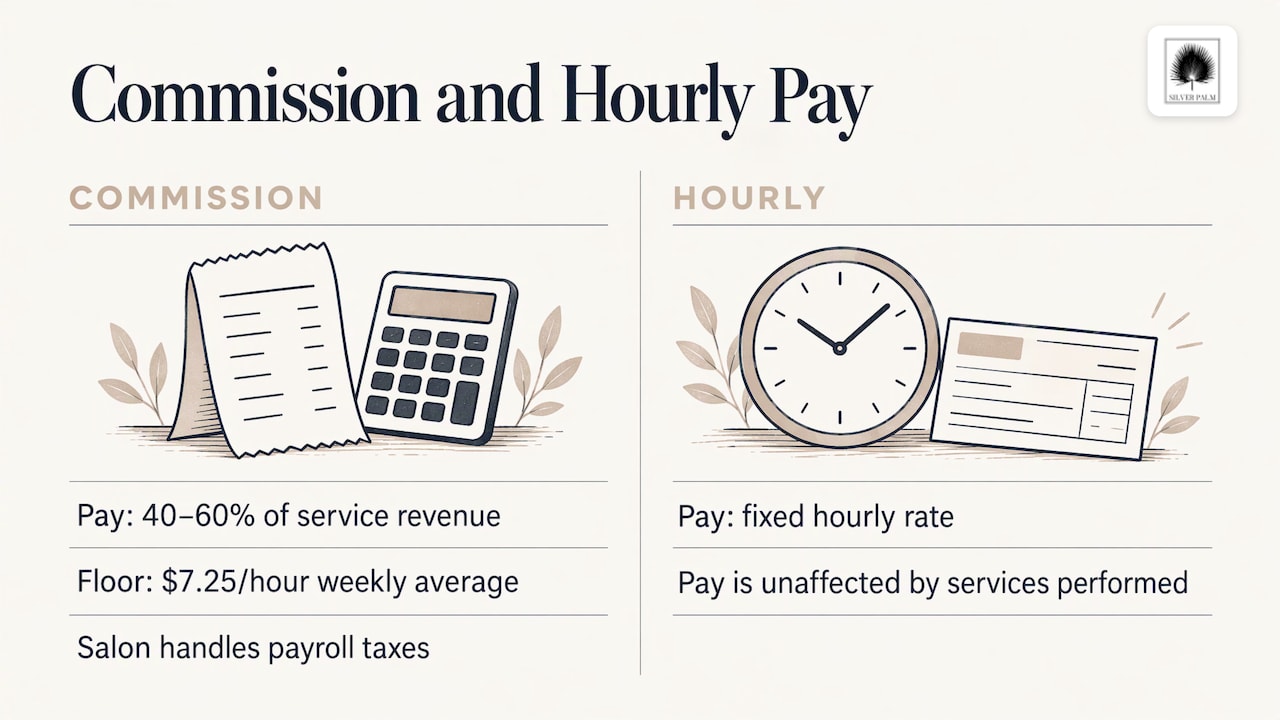
A CPA guide to salon staffing describes commission employees as W-2 workers paid a percentage of the service revenue they produce, with commissions typically running from 40 to 60 percent. In that arrangement the salon handles payroll taxes, workers’ compensation and unemployment insurance, and any benefits. Hourly employees are paid a fixed rate regardless of services performed.
Commission has a legal floor in the US. According to Storm Salon Social’s review of salon commission pay, commissioned employees must still have weekly pay that averages at least the federal $7.25 per hour, and state minimums can be higher. Overtime treatment for commissioned staff also depends on specific federal conditions and can be stricter under state law. If an offer does not look like it respects those floors, ask the salon to explain it before you sign.
Booth and suite rental
Renters are independent contractors who rent a station and keep their own revenue, according to the same CPA guide. That means freedom, but you carry your own taxes, insurance, supplies, marketing and booking. It suits stylists who already have a full book. It is a tough start for anyone who needs the salon to bring clients through the door.
Chains
Chains offer volume and a defined system. The trade-off for many stylists is less say over pricing, product and schedule. They can work well as a first job to build speed, but the clientele is typically focused on quick, value-priced services rather than premium color or skin care.
Full-service luxury salon and spa
This is where the strongest long-term careers tend to form. A salon that combines hair, facials, massage, nails and medspa services draws clients who spend on self-care regularly and who return across several services. For a stylist that means clients arrive already trusting the house, cross-referrals between the hair chairs and the spa, and a natural path to learn adjacent skills. The upscale setting also supports premium pricing for premium work.
What the Money Looks Like
Start with the national baseline. The U.S. Bureau of Labor Statistics reports that the median hourly wage for hairdressers, hairstylists and cosmetologists was $16.95 in May 2024. PayScale’s 2026 figure puts average hair stylist hourly pay at $16.08, based on 194 salary profiles, last updated in August 2026.
These are medians and averages, and they say little about what a busy stylist at a premium salon actually earns. Three things move the number:
- Service mix. Color, balayage, extensions and treatments are longer, higher-ticket services than a standard cut. A salon that does them well gives you more revenue per hour in the chair.
- Tips and retail. Ask whether retail commission is paid and how tips are handled. Modern Salon specifically suggests asking about retail commission, insurance, vacation and sick time, and retirement contributions.
- Book fill rate. A high percentage on an empty chair is worth less than a smaller percentage on a full one. Ask how new stylists get clients and how quickly books typically fill.
Where you work also matters, because wages differ by state and metro area, and cost of living differs even more. Compare any offer against what the same hours would net you locally, not against a national average. The BLS occupational handbook is the place to check current figures for your state.

Questions to Ask Before You Accept
A good interview runs both ways. Take this list with you.
About pay and paperwork
- Is the position commission, hourly, hybrid or rental, and is it W-2 or 1099?
- What is the commission scale, and does it rise with revenue or tenure?
- How are tips, retail commission and product costs handled?
- Is there a contract, and does it include a non-compete? Modern Salon recommends clarifying compensation, benefits, education, contract details and any non-compete before you sign.
About training and growth
- Does the salon run an education program, and what is the timeline for a new hire?
- If you are starting out, what does the assistant or trainee program look like?
- Who mentors you, and how often do you get feedback?
- Can you add services such as extensions, smoothing or bond-repair treatments as you grow?
About clients and booking
- Can you schedule your own clients?
- Is online booking offered, and is it easy for clients to find and request you?
- How are new clients distributed?
Modern Salon highlights the booking process as a question worth asking, including whether you can schedule your own clients and whether online booking is available.
About the team
- How long have the other stylists been there? Long tenures tell you more than any careers page.
- How do team members cover for one another and communicate?
How to Read a Salon’s Culture Before You Join
Culture is the hardest criterion to fake and the easiest to check in person.
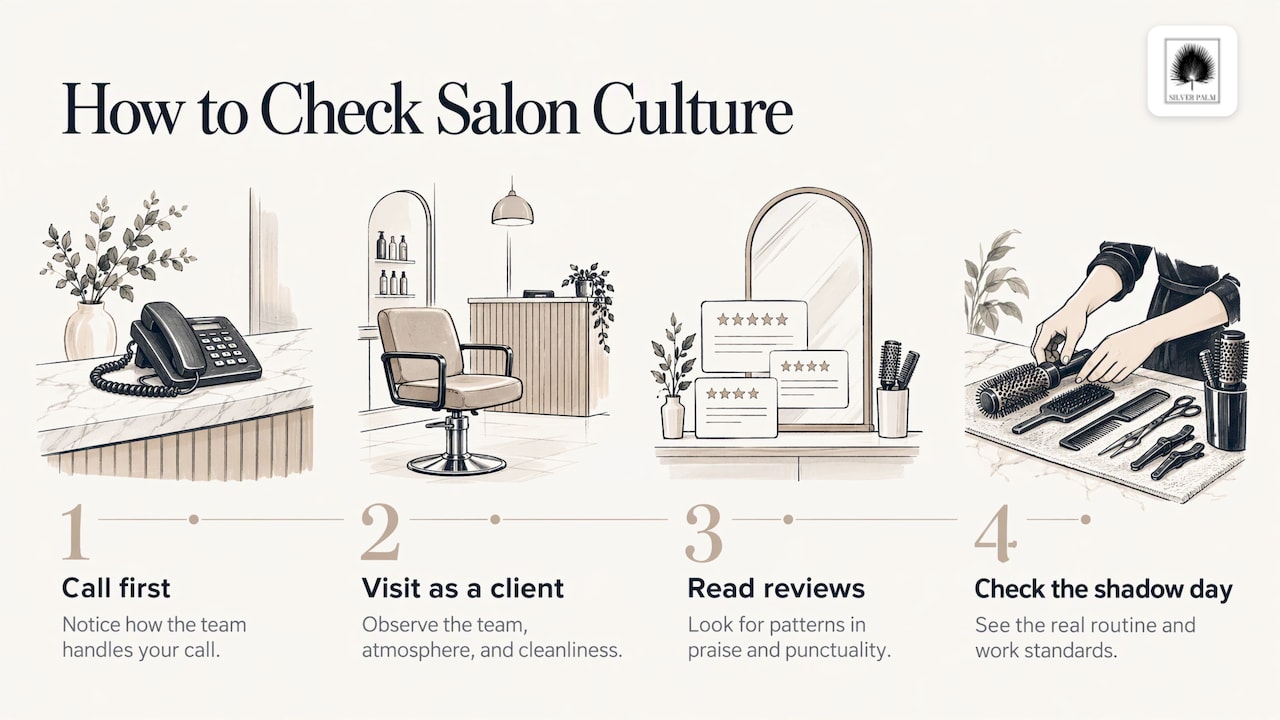
Call first. Modern Salon suggests judging how you are handled on the phone, because the person who answers is the first sign of how the business treats people. Then walk in and notice how you feel, how the team works together and whether the atmosphere looks happy and harmonious.
Visit as a client. The Successful Stylist Academy podcast suggests evaluating salon culture and atmosphere, mentorship, reviews, cleanliness and organization, and the technical interview process. Booking a service is the quickest way to see all of that from the client side, including how the front desk greets people and how the space feels at 2 p.m. on a Thursday.
Read the reviews for patterns. Look for what clients say about the stylists by name, about the atmosphere and about whether visits run on time. Consistent praise for personal attention tells you clients are being looked after, which is exactly what keeps a stylist’s book full.
Check the shadow day. A paid or trial shift, or a technical interview, lets the salon see your work and lets you see the real routine. A salon that wants to see you work before offering a chair is usually one that cares about its standard.
Licensing: What You Need Before Any Salon Hires You
Every salon will ask first whether you are licensed. The BLS states that all states require barbers, hairstylists and cosmetologists to be licensed. Candidates typically complete a state-approved program and pass an exam, and qualifications vary by state. They generally include a minimum age, a high school diploma or equivalent, and graduation from a state-licensed barber or cosmetology school. Some states require continuing education for periodic renewal.
If you are moving, confirm how your current license transfers to the new state’s board before you resign from your current job. Colorado stylists should confirm current requirements with the state licensing office.
Why a Full-Service Salon and Spa Is the Strongest Place to Build a Career
When you put the five criteria side by side, a full-service luxury salon and spa scores well on the ones that last.
A wider service menu means more ways to grow. Silver Palm’s menu in Littleton covers haircuts, color, balayage and highlights, bond repair and smoothing treatments, facials, massage, nails and medspa services. A team that works across hair and spa gives everyone more to learn from and more clients to meet.
Premium clients value premium work. Clients who choose a luxury setting are booking an experience, not just a cut. That is the environment where a detailed balayage or a custom color correction is understood and valued.
Personal attention keeps books full. Silver Palm’s approach centers on personalized service in an upscale, relaxing space. Clients who feel looked after rebook, and rebooking is what turns a new chair into a full one.
Reputation does part of the marketing. A salon with a strong base of positive reviews hands every stylist on the team a head start in credibility.
If you want to see that environment before you decide anything, the simplest step is to experience it as a client. The Silver Palm site shows the full menu and lets you book.
Perspective
We built Silver Palm around one idea: when a visit feels personal and unhurried, clients return, and the people who serve them do their best work.
A luxury salon and spa is more than a room with chairs. Hair, skin and relaxation services sit side by side in one upscale space, and every guest who comes in for one thing is likely to discover another. That is how a salon becomes a destination rather than an appointment.
When we think about what makes a great workplace in this industry, we think about the same things we think about for clients: attention, trust and an atmosphere that is calm rather than chaotic. A beautiful space and a team that respects each other and the craft are the foundation.
If you are weighing salons, we would encourage you to do what we would do: visit, look at the work, notice how people are treated, and trust what you see.
Silver
Red Flags and Green Flags at a Glance
| Green flag | Red flag |
|---|---|
| Pay structure explained plainly and in writing | Vague answers about commission scale or deductions |
| Clear education program and named mentor | “You will learn as you go” with no plan |
| Stylists who have been there for years | Constant turnover and open chairs |
| Online booking that shows each stylist | No system for how new clients reach you |
| Clean, organized, welcoming space | Disorganized back of house |
| Warm, professional phone and front desk | Rushed or dismissive first contact |
| Contract terms you can read and ask about | Non-compete language nobody will explain |
Modern Salon’s advice to ask how long other stylists have worked at the salon remains one of the quickest culture checks there is, because tenure is hard to fake.
A Simple Way to Decide
Score every salon you are considering from 1 to 5 on the five criteria: compensation, training, client flow, culture and stability. Weight the criteria by your own stage.
- Just licensed: weight training and client flow most.
- Two to five years in: weight compensation and the service menu most, so you can add color and treatments.
- Established: weight culture and autonomy most, and decide whether a salon or a rental suite fits your following.
Then visit your top two as a client. The salon where you would happily book your own appointment is usually the one where you will be happy working.
Experience Silver Palm for Yourself
Silver Palm is a luxury salon and spa in Littleton, Colorado, offering hair, facials, massage, nails and medspa services in an upscale, relaxing setting with personalized client care. Browse the full service menu, including women’s haircuts from $75, men’s haircuts from $50 and full balayage from $200, and book a visit to see the standard of work and the atmosphere first-hand.
FAQ
Is it better to work on commission or hourly at a salon?
Commission rewards a full book, while hourly pay gives predictability, which many new stylists value. Either way, commissioned employees must still average at least the federal minimum wage of $7.25 per hour in weekly pay, and state minimums can be higher. Ask for the scale in writing and compare it against your expected bookings.
How much do hairstylists make in the US?
The BLS reports a median hourly wage of $16.95 for hairdressers, hairstylists and cosmetologists in May 2024. Real earnings depend on location, experience, service mix, tips and how full your book is, so use this only as a baseline.
Should I rent a booth or be an employee?
Employees are paid by the salon, which handles payroll taxes and workers’ compensation. Renters are independent contractors who keep their revenue but cover rent, taxes and supplies, according to a CPA guide to salon staffing. Renting generally suits stylists with a following; employment suits those still building one.
What should I ask in a salon interview?
Ask about pay structure, benefits, education and training timelines, how booking works and how long the current team has stayed. Modern Salon also recommends clarifying contract details and any non-compete before signing.
Do I need a license to work in a salon?
Yes. All states require licensing for barbers, hairstylists and cosmetologists, usually through a state-approved program and an exam. Requirements vary by state, so check with your state board.
Sources
- Modern Salon: The Questions Every Stylist Should Ask at a Salon Interview
- U.S. Bureau of Labor Statistics: Barbers, Hairstylists, and Cosmetologists
- PayScale: Hair Stylist Hourly Pay in 2026
- Storm Salon Social: Salon Commission
- Successful Stylist Academy: What To Look For In A Salon
- Blue Cloud CPA: Salon Employee Management