Dehydrated skin needs water, not just oil. Learn what a hydrating facial involves, how often to book, how to prep and when to see a dermatologist first.

A facial for dehydrated skin focuses on getting water into the skin and keeping it there. It uses gentle exfoliation, humectant ingredients such as hyaluronic acid, a sealing mask and a barrier-supporting finish with sun protection. Booked every four to six weeks and backed by a simple routine at home, it can leave skin looking smoother and feeling more comfortable. Below, we explain how dehydrated skin differs from dry skin, what happens in the treatment room, how to prepare and when a dermatologist is the better first stop.
TL;DR
- Dehydrated skin lacks water and can happen to any skin type. Dry skin lacks oil and is a skin type.
- A hydrating facial follows a clear logic: prep, water-binding ingredients, a sealing mask, then barrier protection and SPF.
- Most dermatologists suggest a facial every four to six weeks, and up to every six to eight weeks if your skin is dry or sensitive.
- Pause retinol and exfoliating acids before your visit, and skip the facial if you are sunburned, peeling or reacting.
- Skin that stays dry, itchy or painful despite good care deserves a board-certified dermatologist, not another facial.
Table of Contents
- Dehydrated skin vs. dry skin
- What happens in a facial for dehydrated skin
- Ingredients that actually help hydrate
- How often to book, and how long results last
- Before your appointment
- Aftercare that keeps the hydration
- Perspective: why we customize instead of following one script
- Choosing a facial at Silver Palm
- When to see a dermatologist first
- FAQ
- Sources
Dehydrated skin vs. dry skin
The two get mixed up constantly, and the difference changes what you should do about it. According to Healthline, dehydrated skin lacks water and can affect anyone regardless of skin type, while dry skin (xerosis cutis) is a skin type that lacks oils or lipids. Dehydrated skin can even be oily. Dry skin tends to be lifelong and is often genetic.
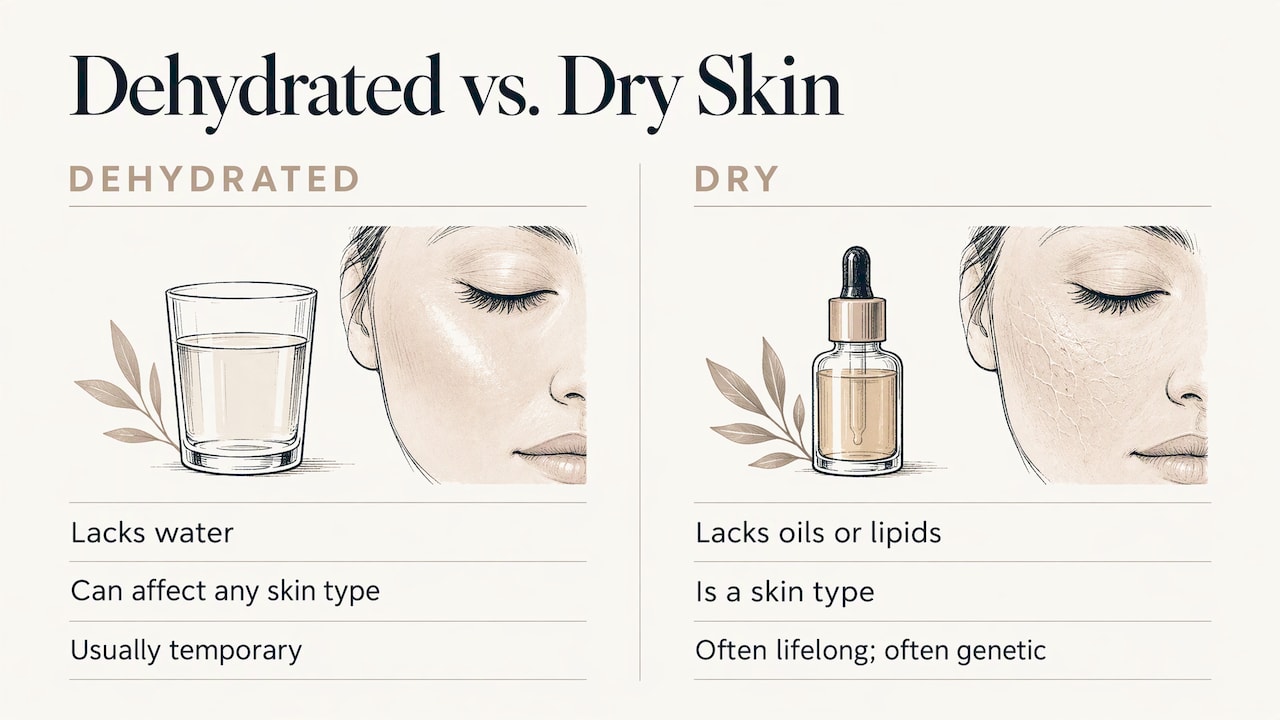
Schweiger Dermatology notes that dehydration is usually temporary and can improve with the right care. One clue they give: if your skin feels tight but turns shiny through the day, dehydration is more likely.
CeraVe explains that healthy skin holds roughly 30% water, and when skin loses more water than it takes in, it can become dehydrated. Common triggers include a damaged skin barrier, very cold and dry weather and too little water in your diet.
Signs your skin is short on water
The usual picture looks like this:
- Tightness or discomfort, especially right after cleansing
- A dull, flat complexion
- Fine lines that look more obvious than usual
- An uneven tone or mild itchiness
- Skin that feels tight yet still looks shiny by afternoon
If several of these sound familiar, UPMC says skin that feels tight after washing is likely dehydrated, and hydration-focused facials can help.
Why Colorado skin dehydrates so easily
Littleton sits in a dry, high-elevation climate, with indoor heating running for much of the colder season. Dry air pulls water from the skin surface faster, so a routine that worked in a humid city can stop working here. If this sounds like you, our guide to the best facials for Colorado’s dry climate goes deeper on matching treatments to local conditions.
What happens in a facial for dehydrated skin
A professional hydration facial is built around one idea. Luminous Skin Lab’s 2026 protocol guide describes the core logic: prepare the skin surface, deliver water-binding actives, lock them in with an occlusive mask, then seal the barrier against water loss.
In practice, a visit tends to run like this.
- Cleansing and skin analysis. Your esthetician removes makeup and surface oil, then looks at your skin and asks about your routine, products and recent treatments. This is when you mention retinol, new products or recent sun.
- Gentle exfoliation. Byrdie lists a typical facial as seven steps: cleansing, analysis, exfoliation with AHAs, BHAs or enzymes, extractions if needed, massage, a mask suited to your skin type and moisturizer with SPF. For dehydrated skin, exfoliation is kept mild so the barrier is not stressed further.
- Hydrating serum. Humectant ingredients draw water into the skin. Hyaluronic acid is the best known. UPMC notes that hydrating facials may include it, since it holds water in the skin and helps reduce flakiness.
- Massage. Beyond feeling good, it supports product application and relaxes the face.
- Sealing mask. The Luminous Skin Lab team calls the mask phase the highest-leverage step, because an occlusive mask over a humectant serum creates a closed environment that slows water loss during the treatment.
- Barrier serum, moisturizer and SPF. The same guide stresses that this finish determines how long results last. Without a humectant serum and SPF in your daily routine, they say in-treatment results can rebound within 24 to 48 hours for many clients.
That last point matters: the facial is a reset, and your home routine is what keeps the result.
Ingredients that actually help hydrate
Whether your esthetician uses them in the treatment room or you buy them for home, three groups do most of the work.
| Ingredient type | What it does | Examples |
|---|---|---|
| Humectants | Draw water into the skin | Hyaluronic acid |
| Barrier lipids | Help skin retain the water it has | Ceramides, squalane |
| Occlusives | Seal the surface to slow water loss | Petroleum jelly-based products, occlusive masks |
Cleveland Clinic recommends moisturizers with ceramides to strengthen the barrier, hyaluronic acid (which declines with age) and squalane, which can soothe redness while boosting moisture. Board-certified dermatologist Dr. Daniel Sugai explains on CeraVe’s site that ceramides make up about 50% of the skin’s lipids that form the natural barrier, and that hyaluronic acid pulls in moisture while ceramides help keep it there. Pairing the two is the logic behind most good hydration routines.

How often to book, and how long results last
Skin renews itself roughly every 28 to 40 days. According to UPMC, most dermatologist-approved facials can happen as often as every four to six weeks. For dry or sensitive skin, every six to eight weeks is usually enough.
Byrdie reports the same four to six week guidance, and quotes Dr. Reszko warning that going sooner can irritate skin and compromise the barrier. More is not better here.
For most people, a good rhythm looks like a facial at the start of the dry season, then one every month or two while the air stays dry, with a hydrating routine at home in between.
Before your appointment
A little prep makes the treatment work better and lowers the chance of irritation. Byrdie advises that before a facial you:
- Pause products with exfoliating acids, retinol or retinoids for up to a week
- Avoid excess sun and sunburn
- Arrive with clean skin and no makeup if possible
- Drink plenty of water
UPMC adds that you should avoid facials if you are sunburned, peeling or recovering from a reaction. Tell your esthetician about any prescription skin products, recent injectables or peels so the treatment can be planned around them.
Aftercare that keeps the hydration
After your facial, Byrdie’s guidance is to avoid touching your face, heavy sweating and extreme heat, and to go makeup-free for about 24 hours.
For the days that follow, these habits protect the result:
- Use lukewarm water. Cleveland Clinic advises skipping hot water and avoiding rubbing or scrubbing.
- Moisturize within five minutes of washing. Damp skin takes up moisture better. Pat dry gently rather than rubbing.
- Skip drying products. Cleveland Clinic names retinol and astringent toners as products to avoid while skin is dehydrated.
- Wear broad-spectrum SPF every morning. Colorado sun is strong, and sun protection is part of what keeps the barrier intact.
- Consider a night seal. For a dry spot, Cleveland Clinic suggests a thin dab of a petroleum jelly-based product before bed. If your whole face feels dry, it describes slugging with a thin layer, and says to stop if pimples develop.
Redness, irritation or breakouts can happen after facials, especially after extractions or strong exfoliants. Dr. Garshick, quoted in Byrdie, advises sensitive skin types to choose gentler treatments and avoid harsh actives. Say so at the start of your visit.
Perspective: why we customize instead of following one script
Dehydration is not one problem with one fix. Two clients can both say their skin feels tight, and one is dealing with winter heating while the other has a barrier that has been over-exfoliated. That is why we do not believe in a single hydrating facial for everyone.
At Silver Palm, we approach every facial as a conversation first. Our Signature Custom Facial is designed to be tailored to the skin in front of us, and our DermaSweep Facial is another option for clients who want a skin-smoothing treatment. We start with what your skin looks like and feels like today, what you use at home and how Colorado’s air has been treating you.
We also believe a facial should feel like a reset for you, not just your skin. A calm room, unhurried hands and a plan you can actually follow at home are what make the results worth coming back for.
Silver
Choosing a facial at Silver Palm
We offer two facials at our Littleton salon and spa: the Signature Custom Facial and the DermaSweep Facial. Pricing is not published online, so we confirm it when you book. If you have dehydrated skin, tell us when you schedule, and we will talk through which treatment suits your skin and your goals. You can see both on our Littleton facials page, or read our overview of facial types, prices and how to choose if you are comparing options across the Denver area.
If you want to go further than a facial, we also offer medspa treatments such as microneedling and chemical peels. These work differently from a hydrating facial and are better discussed with our team in person once your skin is calm and well hydrated.
When to see a dermatologist first
A facial is cosmetic skin care. It is not a treatment for a medical skin condition. The American Academy of Dermatology says that if dryness continues after you have tried dermatologist-recommended tips, see a board-certified dermatologist. Persistent dryness may be linked to an underlying condition such as atopic dermatitis, psoriasis or kidney disease, and without treatment both the dryness and the condition can worsen.
Book a dermatologist before a facial if:
- Your skin stays dry, itchy or flaky after a few weeks of gentle care
- Moisturizer or other products burn, sting or cause irritation. The AAD says to tell your dermatologist when that happens
- You have visible rashes, cracked or weeping skin
- You are currently sunburned, peeling or reacting to a product
The AAD also advises asking a dermatologist before using anti-itch creams on very dry skin, since some contain ingredients that can irritate it further. Once a dermatologist has cleared you, a gentle facial can be a good complement to your care plan.
FAQ
What is the best facial for dehydrated skin?
The best choice is a customized facial that uses gentle exfoliation, a humectant serum such as hyaluronic acid, a sealing mask and SPF at the end. Aggressive exfoliation works against you when your barrier is already stressed. Our Signature Custom Facial is designed to be tailored to your skin on the day.
How often should I get a facial for dehydrated skin?
Most dermatologist-approved facials can be done every four to six weeks, according to UPMC. If your skin is dry or sensitive, every six to eight weeks is usually enough. Going more often than your skin’s renewal cycle can cause irritation.
Should I moisturize if my skin is dehydrated?
In most cases, yes. Healthline notes that people with dehydrated skin may be able to skip heavy moisturizers, but hydration-focused products with humectants still help. Cleveland Clinic advises applying moisturizer within five minutes of washing your face. If you are unsure whether your skin is dry or dehydrated, a licensed esthetician can help you tell.
Can I wear makeup after a hydrating facial?
It is best to go makeup-free for about 24 hours, according to Byrdie’s guidance. Avoid sweating heavily and extreme heat during that time too. Wear sunscreen if you head outside.
Sources
- Dry vs. Dehydrated Skin: Treatments and How To Tell the Difference (Healthline)
- Dry vs Dehydrated Skin: How to Tell the Difference (Schweiger Dermatology)
- Dry or Dehydrated Skin: What’s the Difference? (CeraVe)
- Do Facials Really Help Your Skin? (UPMC)
- Building a Hydration Facial Protocol for Estheticians (Luminous Skin Lab)
- Facials 101: How to Choose a Treatment and What to Expect (Byrdie)
- Tips for Getting Rid of Dry Skin on Your Face (Cleveland Clinic)
- Facial Moisturizing 101 (CeraVe)
- How Often Should You Get a Facial? (Byrdie)
- Dermatologists’ top tips for relieving dry skin (American Academy of Dermatology)