Rough, bumpy or uneven skin texture has clear causes and proven fixes. Learn what to do at home, what to avoid, and when a facial or medspa treatment helps.

Rough skin texture usually comes from dead cells building up on the surface, a dry or irritated skin barrier, or a common condition such as keratosis pilaris. Most of it improves with gentle exfoliation, steady moisture and daily sunscreen. When home care stalls, a professional facial or a medspa treatment such as a chemical peel or microneedling can take over, and that is where we come in at Silver Palm in Littleton.
This guide explains what is going on in your skin, what to do about it step by step, which ingredients have real evidence behind them, and how to tell when a bump or patch needs a doctor instead of a facial.
Key Takeaways
- Rough texture is most often dead-cell buildup, dryness, sun damage or keratosis pilaris, and each responds to a different approach.
- Exfoliate the face once or twice a week, use one exfoliant at a time, and always follow with moisturizer and sunscreen.
- Over-exfoliating is the most common way people make texture worse. Retinoids, retinol and benzoyl peroxide raise the risk of irritation.
- Professional options, including facials, peels and microneedling, suit texture that has not moved after several weeks of consistent home care.
- A bump that bleeds, does not heal or changes shape should be seen by a dermatologist, not treated as a texture problem.
Table of Contents
- What Rough Skin Texture Actually Is
- The Most Common Causes
- A Routine That Smooths Skin Without Wrecking It
- Ingredients With Evidence Behind Them
- Rough Bumps on Arms and Thighs
- When Home Care Is Not Enough
- When to See a Dermatologist
- Our Perspective
- Ready for Smoother Skin in Littleton
- FAQ
- Sources
What Rough Skin Texture Actually Is
Skin texture is how your skin feels and looks up close: smooth and even, or bumpy, flaky, dull and coarse. Your outer layer sheds dead cells all the time. When that shedding slows, or the cells stick together faster than they leave, the surface turns rough. Health.com describes textured skin as usually a buildup of dead surface cells or a condition such as acne or eczema, with genetics, sun damage, dehydration, diet and smoking also playing a part.
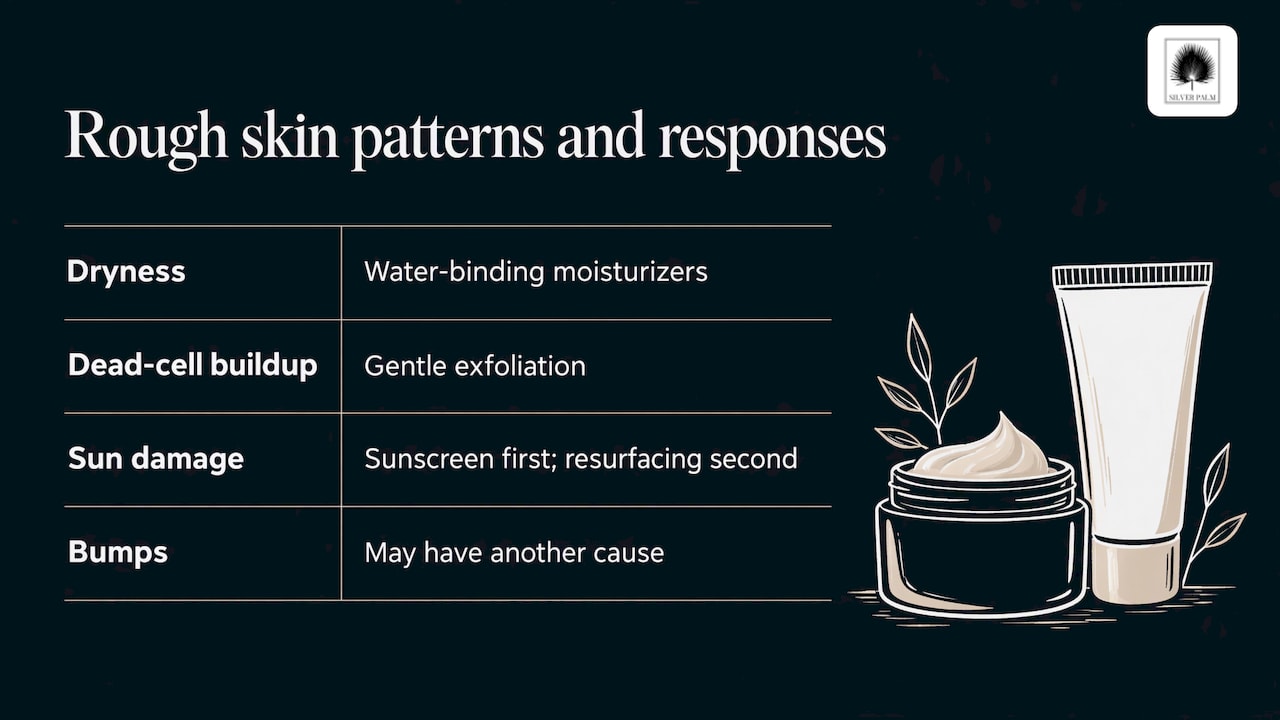
That is why one routine does not fit everyone. Rough skin from dryness needs water-binding moisturizers. Rough skin from buildup needs gentle exfoliation. Rough skin from sun damage needs sunscreen first and resurfacing second. Bumps on the upper arms or cheeks may be something else entirely.
The Most Common Causes
Dead-cell buildup and a tired skin barrier
When dead cells pile up, skin looks dull and feels sandpapery, and pores can clog. If your skin also feels tight after cleansing, the barrier that holds in moisture may be worn down. Long hot showers, harsh cleansers, scrubbing and over-exfoliating all contribute. The American Academy of Dermatology (AAD) is a dermatologists’ professional body, and its guidance on safe exfoliation is built around avoiding exactly that kind of overdoing it.
Dryness, and Colorado’s climate
Dry skin looks flaky and feels rough, and it tends to get worse in winter and in low-humidity places. Littleton sits in one of the driest regions of the country, so many locals notice texture changes between seasons. If that sounds familiar, our guide to facials for Colorado’s dry climate covers what helps, and our page on a facial for dehydrated skin explains what to expect in the treatment room.
Sun damage
Years of unprotected sun break down collagen and leave skin coarse, uneven and dry. Daily broad-spectrum sunscreen of SPF 30 or higher is the base of any texture plan, including on cloudy days and when you work from home, according to Health.com. At 5,000 feet above sea level, Colorado sun is strong, so this step matters more here than most people expect.
Keratosis pilaris
If the roughness is tiny, dry bumps on the upper arms, thighs or cheeks, it may be keratosis pilaris. The Mayo Clinic explains that keratin, a hard protective protein, forms scaly plugs that block hair follicle openings. It cannot be cured or prevented, it usually fades by about age 30, and dry skin tends to make it worse. It is harmless, and the goal is smoother skin, not a cure.
Clogged pores and breakouts
Bumps across the forehead, chin or cheeks that are not itchy and not dry are often congested pores. Our guide to clogged pores and when a facial helps walks through safe fixes.
A Routine That Smooths Skin Without Wrecking It
This is the order we would suggest to a friend. Each step is simple, and the common mistakes are where results are lost.
- Cleanse gently. Use a mild cleanser and lukewarm water. Long hot showers and stripping cleansers dry skin out. The AAD advises rinsing after exfoliation with lukewarm, not hot, water.
- Exfoliate on a schedule, not by feel. Cleveland Clinic recommends exfoliating the face once or twice a week and the body two to three times a week. More is not better.
- Pick one type of exfoliant. Cleveland Clinic advises using only one exfoliant at a time, and never a physical scrub right after a chemical one.
- Moisturize every day. Verywell Health recommends moisturizing once or twice daily with ceramides or hyaluronic acid, which help skin hold water and protect the barrier.
- Wear sunscreen every morning. It prevents new roughness and protects the fresh skin exfoliation reveals.
- Give it time. Texture changes over weeks, not days. If nothing has moved after about two months of consistent care, a professional assessment is the sensible next step.
Physical versus chemical exfoliation
The AAD describes two methods. Mechanical exfoliation uses a brush, pad, sponge or scrub. Chemical exfoliation uses alpha and beta hydroxy acids (AHAs and BHAs), which loosen the bonds between dead cells so they shed. If you use a scrub, the AAD says to apply it gently in small circular motions for about 30 seconds, rinse with lukewarm water, and never exfoliate over cuts, wounds or sunburned skin.
For bumpy skin in particular, Cedars-Sinai dermatologists advise against heavy physical scrubbing because it is easy to get too aggressive. Chemical exfoliation is generally the gentler route for facial texture.
For arms, legs and other body areas, a body scrub can be part of the routine. A plant-based exfoliating body scrub used within the two-to-three-times-a-week limit is one way to do it, with moisturizer right afterward.
Ingredients With Evidence Behind Them
Not every smoothing product is equal. Here is what the research supports.
| Ingredient | What it does | What to know |
|---|---|---|
| Glycolic acid (AHA) | Loosens dead cells on the surface | A 2025 network meta-analysis of 23 randomized trials found it the most effective topical agent for improving skin roughness |
| Lactic acid (AHA) | Gentler exfoliation, also hydrating | Listed by Cedars-Sinai among the exfoliants dermatologists recommend for bumpy skin |
| Salicylic acid (BHA) | Works inside pores | Useful where texture comes with clogged pores or breakouts |
| Urea and ammonium lactate | Soften and dissolve dead-cell plugs | Commonly used for keratosis pilaris on the body |
| Retinol and tretinoin | Speed up cell turnover | The same meta-analysis found both effective for roughness; tretinoin had the most favorable safety profile. Tretinoin is prescription-only |
| Ceramides, hyaluronic acid | Support the barrier and hold water | Recommended once or twice daily |
Strength matters. A literature review notes that the FDA has advised caution with AHA products because they can cause redness, swelling, burning and itching, and that high concentrations act as chemical peeling agents that disrupt the skin barrier, while low concentrations may be beneficial. News-Medical reports that AHA concentrations of 2 to 10% flatten dead-cell plugs and that clinicians typically start prescription tretinoin at 0.025% or retinol at 0.25% and then adjust.
How to start an active ingredient safely
- Patch-test first. Cleveland Clinic advises testing chemical exfoliants on your arm before the face.
- Go slowly with retinoids. Cedars-Sinai suggests starting retinol or a prescription retinoid every other night and working up to nightly as your skin tolerates it.
- Do not stack irritants. The AAD warns that exfoliating while using prescription retinoids, retinol or benzoyl peroxide can worsen dryness or trigger breakouts.
- Take extra care with deeper skin tones. The AAD says people with darker skin tones should avoid strong chemical or mechanical exfoliation, because aggressive exfoliation can lead to increased pigmentation or dark spots.
- Stop if skin burns, peels or stays red. Return to a plain cleanser and moisturizer until it calms.

Rough Bumps on Arms and Thighs
For keratosis pilaris, Nationwide Children’s Hospital advises a daily gentle, unscented moisturizer, which can improve how the bumps look. Moisturizers with ceramides, mild acids or urea can help clear the plugs. If the bumps itch, a mild topical corticosteroid can be used, and harsh exfoliators, picking and constant rubbing should be avoided. Expect improvement, not perfection, and expect it to be better in humid months.
When Home Care Is Not Enough
If you have been consistent and the texture is still there, the cause is often deeper than a product can reach: sun-related roughness, old breakout marks, enlarged congested pores, or dehydration that keeps coming back. This is where professional treatment earns its place. A trained esthetician can assess your skin, choose the right level of exfoliation for it, and apply treatments at a strength and consistency that store-bought products are not designed for.
At Silver Palm, the options that relate to texture include:
- Facials. Our Signature Custom Facial and DermaSweep Facial are among our facial services, alongside LED therapy and high frequency skin treatments.
- Chemical peels. Superficial peels use exfoliating acids such as glycolic acid to resurface the skin.
- Microneedling. A resurfacing treatment from our medspa menu.
Treatments vary by skin type and goal, so we recommend booking a consultation and telling us what you have already tried.
What the research says about peels and skin of color
If you have a deeper skin tone, the type and depth of treatment matter a great deal. A peer-reviewed review in the Journal of Cosmetic Dermatology reported that a study of five superficial peels found a 3.8% complication rate in Fitzpatrick skin types III to VI, with all side effects resolving within eight months, and that superficial peels are considered safest for skin of color. The same review notes that microneedling does not destroy the full thickness of the epidermis, which lowers the chance of post-inflammatory hyperpigmentation and makes it an advantageous resurfacing option for skin of color.
A 2024 article in Clinical, Cosmetic and Investigational Dermatology concludes that superficial peels such as glycolic acid are safe for patients with skin of color when started at a low concentration and adjusted between visits. It advises avoiding medium-depth peels as much as possible and deep peels at all times. In practice, this is why a gradual plan, built around your skin and checked at each visit, beats a single strong treatment.

Before any resurfacing treatment
The AAD’s guidance on microdermabrasion names situations where you should see a dermatologist first, whether the treatment is at a spa or an at-home kit: a growing, bleeding or changing mole or spot, isotretinoin use within the past 6 months (a higher scarring risk), or skin that scars easily. After a treatment, skin may be pink, red or slightly swollen, which usually fades within a day. Tell your esthetician about any prescription retinoids, recent sun exposure and past reactions before you start.
When to See a Dermatologist
Not every bump is a texture issue. See a dermatologist, not a spa, if you have:
- Bumps that itch constantly or bleed
- A pink or pearly bump that bleeds or does not heal. Cedars-Sinai notes that basal cell carcinoma, the most common skin cancer, can look like this
- A mole or spot that is growing, changing or bleeding
- Sudden roughness with rash, swelling or pain
Skin checks come first. Once a doctor has ruled out anything concerning, facial and medspa care can focus on how your skin looks and feels.
Our Perspective
We see skin texture as a long game with a simple foundation: protect the barrier, exfoliate at a pace your skin can handle, and keep it hydrated. The people who struggle most are usually not doing too little. They are doing too much, stacking scrubs, acids and retinol in the same week.
That is why we start with a conversation about your skin, not a menu. Our Signature Custom Facial is built around the individual, and our personalized approach is the point of Silver Palm: your skin, your goals, your pace. For texture that needs more than a facial, our medspa offers chemical peels and microneedling in the same relaxed, upscale setting as the rest of our services.
Good texture is rarely one treatment. It is a plan you can keep up, with home care that supports what we do in the treatment room.
Silver
Ready for Smoother Skin in Littleton
If you want a professional plan for rough or uneven texture, start with a facial at Silver Palm and tell us what your skin feels like, what you use at home and what you want to change. If you are considering peels or microneedling, our medspa services page lists what we offer. Prices for these services are not published on our site, so ask when you book.
FAQ
How do I get rid of rough skin on my face?
Start with a gentle cleanser, a ceramide or hyaluronic acid moisturizer, and daily SPF 30 or higher. Add one exfoliant, such as a glycolic or lactic acid product, once or twice a week. If skin has not improved after several weeks, a professional facial or peel can go further.
What is the best treatment for uneven skin texture?
It depends on the cause. Dryness needs hydration, buildup needs exfoliation, and sun-related roughness often benefits from retinoids and resurfacing treatments. In the 2025 meta-analysis, glycolic acid was the most effective topical for roughness, and tretinoin had the strongest safety profile, but tretinoin requires a prescription.
Why did my skin suddenly get rough?
Common triggers are weather changes, over-exfoliating, a new product, hot showers, or starting a retinoid. Return to a gentle cleanser, moisturizer and sunscreen for a couple of weeks. If it comes with a rash, pain or a non-healing spot, see a dermatologist.
How often should I exfoliate rough skin?
Cleveland Clinic recommends once or twice a week for the face and two to three times a week for the body. Use one exfoliant at a time and follow with moisturizer. Skip exfoliation on sunburned, irritated or broken skin.
Can rough bumps on my arms be fixed?
If they are keratosis pilaris, they can be softened but not cured. Daily moisturizing, and products with urea, ceramides or mild acids, can help, and picking or harsh scrubbing makes it worse. It often improves with age.
Sources
- Keratosis pilaris: symptoms and causes, Mayo Clinic
- 8 Treatments That Can Improve Your Skin Texture, Health.com
- How to safely exfoliate at home, American Academy of Dermatology
- Bumpy Skin: Do I Need Treatment? Cedars-Sinai
- How To Exfoliate Safely and Effectively, Cleveland Clinic
- 13 Dermatologist-Approved Tips to Improve Skin Texture, Verywell Health
- Comparative efficacy of topical interventions for facial skin roughness, 2025 network meta-analysis
- The Effectiveness of Topical Keratolytics, 2025 literature review
- Do Popular Skincare Ingredients Like Niacinamide and Retinol Actually Work, News-Medical
- Keratosis Pilaris: Symptoms, Diagnosis and Treatment, Nationwide Children’s Hospital
- Microdermabrasion: FAQs, American Academy of Dermatology
- Cosmetic Procedures in Patients with Skin of Color, Journal of Cosmetic Dermatology
- Cosmetic considerations in dark-skinned patients, Clinical, Cosmetic and Investigational Dermatology