How commission hair stylist jobs pay, what typical splits look like, and which questions to ask before you accept an offer, with federal and Colorado wage rules.
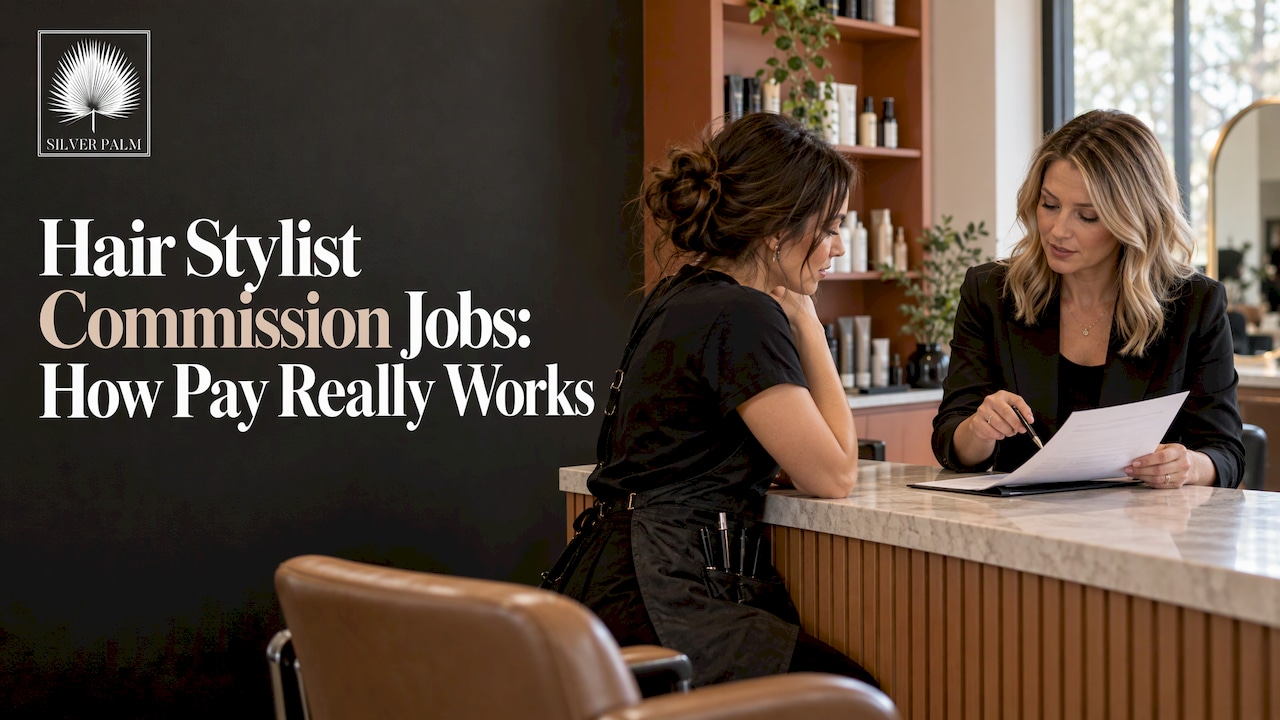
A commission hair stylist job pays you a percentage of the services you perform, and you work as a salon employee instead of renting your own space. The percentage, how it is calculated and what the salon provides in return decide whether the job is a good one. This guide explains each piece so you can read an offer clearly, whether you are searching in Littleton, across the Denver area or anywhere else in the US.
Key Takeaways
- A commission stylist is typically a W-2 employee paid a share of service revenue, while the salon supplies the chair, products, booking system and clients.
- Commission rates commonly fall between 30% and 60% of service sales, and the real number depends on whether it is calculated on the menu price or on a net figure.
- Commission never cancels minimum wage: federal and Colorado rules require your total pay to reach the minimum for the hours you worked.
- Tips are yours, and they do not count toward your commission.
- Ask for the split, the calculation method, the tier thresholds and the education on offer in writing before you accept.
Table of Contents
- What a commission hair stylist job is
- What commission pays in practice
- Example: what a month can look like
- How this compares with national pay figures
- Wage rules every commission stylist should know
- Commission or booth rental?
- Questions to ask before you accept an offer
- Licensing and where to go next
- See the Silver Palm experience
- FAQ
- Sources
What a commission hair stylist job is
In a commission salon, the salon hires stylists as employees and pays them a percentage of the service revenue they generate. The salon collects the client’s payment, sets the prices and service menu, runs the schedule and covers its employer share of payroll costs, including 7.65% FICA, workers’ compensation and unemployment insurance. FICA is the combination of Social Security and Medicare taxes that employers and employees each pay a portion of.
That is the main difference from renting a booth or suite, where you run your own small business. As an employee you do not buy your own insurance policy for the business, chase your own marketing or manage a payment system. You trade some upside for stability and support.
What commission pays in practice
There is no single national rate. Commission salons describe service commissions ranging from roughly 30% to 60%, with retail commissions from 10% to 20%. Another industry guide puts typical US rates at 35% to 60%, either as a flat percentage or as a sliding scale that rises as your total service sales rise.
A useful way to read a rate is to turn it into weekly money. A stylist who produces $2,000 in weekly service revenue earns about $1,000 a week at a 50% split, roughly $52,000 a year before taxes. At 40%, the same revenue yields $800. Your starting rate usually reflects experience, the type of service and what the salon gives you in return, such as clients, products and marketing.
Gross versus net calculation
Two salons can both say “45%” and pay differently. When commission is calculated on gross, you earn a percentage of the menu price. When it is calculated on net, the salon first subtracts costs such as card fees and product. As one worked example shows, a $200 color at 40% pays $80 on gross. On net, with a $6 card fee and $34 of product deducted, it pays 40% of $160, or $64.
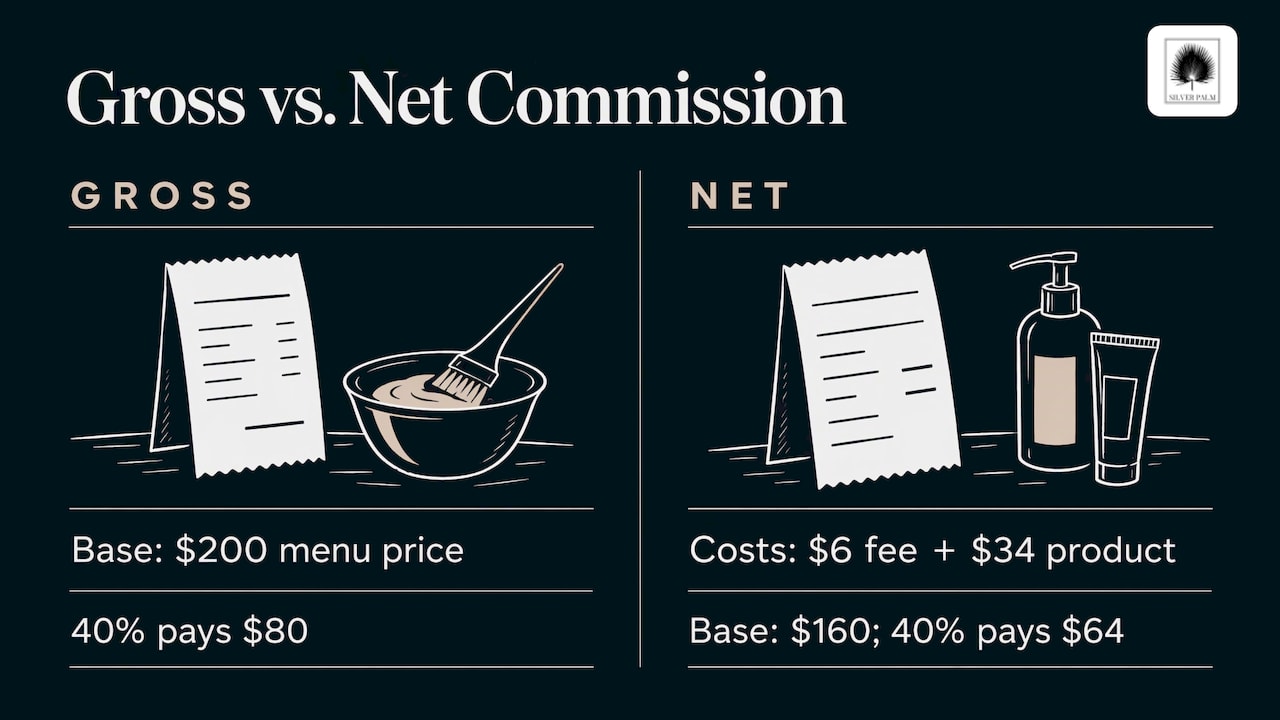
In a 2023 survey of salon owners and staff, 60% said nothing is deducted from commission. That makes the question worth asking directly in every interview. The same guide’s key rule is that the salon must never change the calculation criteria after the service has been done. Get the method in writing on day one.
Tiers and sliding scales
Many salons raise your percentage as your sales grow. The common structures are straight commission, tiered or level-based commission, and hourly pay plus commission. A review of 84 top-rated US salons’ hiring pages found entry-level tiered earnings around $40,000, with top levels reaching about $96,000 at one salon and $214,000 at another. Ask what sales figure moves you up a tier, how often it is measured and whether you keep the higher rate once you reach it.
Example: what a month can look like
Take a stylist at a 45% commission with a tier that moves to 50% above $9,000 in monthly service sales.
| Monthly service sales | Rate | Commission before tips and taxes |
|---|---|---|
| $6,000 | 45% | $2,700 |
| $8,000 | 45% | $3,600 |
| $10,000 | 50% | $5,000 |
The jump from $8,000 to $10,000 in sales adds $1,400 in commission, because the higher rate applies to the whole month in this example. Not every salon works that way. Some apply the higher rate only to sales above the threshold, so ask which version the salon uses.
A single service shows the same logic. A $75 haircut at 45% earns the stylist $33.75 before tips. Add a $45 deep conditioning treatment in the same visit and the ticket grows, and so does your share. Stylists who build a returning clientele and attach add-on treatments move up tiers faster.
How this compares with national pay figures
The Bureau of Labor Statistics reports a 2025 median of $35,880 a year ($17.25 an hour) for barbers, hairstylists and cosmetologists, with a 7% job outlook for 2025 to 2035. For hairdressers and hairstylists, the lowest 10% earned under $13.00 an hour and the highest 10% over $34.23, and tips are included in those figures.
Those numbers cover employees. The same BLS page notes that many stylists are self-employed, and official wage data largely leaves them out. A 2023 industry study built from W-2 forms found full-time hairstylists averaging $79,807 a year, with 24% earning at least $100,000. The practical lesson is that your own earning range depends on your book of clients, your hours and your split, far more than on a national median.
Wage rules every commission stylist should know
Minimum wage still applies
Commission is a form of wages, not a replacement for them. Your total pay for a workweek, divided by the hours you worked, has to reach the minimum wage. If a slow week leaves you short, the salon has to make up the difference. In Colorado, employees paid by commission must still receive the state minimum wage, which is $15.16 an hour in 2026. Some cities set a higher local minimum, so check the rate for the city where the salon is located. The state figure is updated each year, so confirm the current rate with the Colorado Department of Labor and Employment.
Overtime
The federal Fair Labor Standards Act has a special overtime exemption for commissioned employees of retail or service businesses. It applies only if your regular rate is above 1.5 times the applicable minimum wage and more than half of your earnings over a representative period come from commissions. That period must be at least one month and no longer than a year, and tips cannot be counted as commissions. If you do not meet those tests, you are owed overtime for hours past 40 in a week.
Tips
Tips belong to you. Under the Department of Labor’s guidance, as summarized in a 2026 payroll guide, card tips must be paid by the regular payday, less at most the card processing fee. Employers cannot keep any of them. Report tips of $20 or more in a month to the salon by the 10th of the following month, and expect income tax and FICA to be withheld.
Commission or booth rental?
This is the choice most stylists weigh after a few years behind the chair. A booth renter is an independent contractor who pays fixed rent, keeps the service revenue, sets prices and hours and pays self-employment tax of 15.3%, plus quarterly estimated taxes. A commission stylist is an employee with taxes withheld and, at some salons, paid time off, health insurance or a 401(k).
The IRS draws a clear line between the two. Its guide for the cosmetology and barber industry says a true renter has a key, sets their own hours, buys their own products, has their own phone and business name and sets their own prices. If those are missing, the worker is likely an employee.
For a newer stylist, commission has a practical appeal: the salon brings the clients, the products and the booking system, and you spend your time building technical skill and a following. The Storm Global review found education was the most common offering on salon hiring pages, listed by 48 of 84 salons, followed by apprentice or associate programs at 33. If you are early in your career, that structure is often worth more than a slightly higher percentage somewhere with no training.
Questions to ask before you accept an offer
In that same review, 53 of 84 hiring pages said nothing about how pay works, and only five published a percentage. So the interview is where you get the details. Bring this list:
- What is my starting split, and is it on gross or net sales?
- Are card fees, product costs or other items deducted before commission?
- Is there a tier structure, and what are the thresholds?
- How is retail commission paid?
- Is there an hourly base or guarantee while I build my book?
- How are walk-ins and new clients assigned?
- What training, education and mentorship are included?
- Are there paid time off, health insurance or retirement benefits?
- How are chair-side changes, like an added gloss, recorded for pay?
The last one matters more than it seems. A common source of pay disputes is calculating pay from what was booked instead of what was performed, because add-ons and overruns make the appointment book unreliable. A salon that records services at the point of service gives you a pay record you can trust.
If you are also working out how to price and present your own services, a clear service menu structure for beauty pros shows how menus and pricing shape the tickets your commission is built on.
Licensing and where to go next
Colorado requires a state license to work as a cosmetologist, and a salon will ask for it before you start. For a fuller walk through roles, pay, licensing and what to expect, see our guide to hair stylist jobs, and our comparison of how stylists weigh the best salon to work for.
What we believe about a good salon workplace
At Silver Palm, we are a luxury salon and spa in Littleton, and we build everything around personalized attention and an upscale, relaxing environment. Clients feel that when they sit down, and we think it begins with how a salon treats its own people.
A stylist’s pay should be easy to understand. Whatever the split, you should know the method and see it applied the same way every pay period. Clients return to stylists they trust, and trust is built on clear expectations on both sides of the chair.
Our menu spans haircuts, color, highlights, treatments, facials, massage, nails and medspa services. A salon with that range gives a stylist’s clients more ways to be taken care of in one place, and a place where every visit is meant to feel memorable and satisfying is a place worth building a career around.
Silver
See the Silver Palm experience
If you want to see the standard we hold ourselves to, start with our hair services in Littleton. Women’s haircuts start at $75 and men’s haircuts at $50, with balayage from $200, all-over color from $120 and partial highlights from $150. You can book online or in person.
FAQ
How much do hair stylists make on commission?
It depends on your split, your sales and your hours. Commission rates commonly run from 30% to 60% of service revenue. At a 50% split, $2,000 in weekly service sales pays about $1,000 before tips and taxes. Federal data puts the 2025 median for the occupation at $35,880 a year, but top earners with full books earn well above that.
What is a commission hair stylist?
A commission hair stylist is a salon employee, usually on a W-2, who is paid a percentage of the revenue from the services they perform. The salon sets prices, supplies products and the booking system and handles payroll taxes. Some salons add an hourly base, benefits or a tiered rate that rises with sales.
Is it better to booth rent or work on commission?
Commission suits stylists who want clients, training and administration handled by the salon while they build skill and a following. Booth rental suits experienced stylists with a loyal clientele who want to set their own prices and hours and handle self-employment tax, insurance and marketing. The IRS looks at who controls the keys, hours, products and prices to decide which one a stylist is.
Does commission pay count toward minimum wage?
Yes. Commission counts as wages, and your total pay for the week divided by hours worked must reach the minimum wage. In Colorado the 2026 statewide minimum is $15.16 an hour, and the salon covers any shortfall in a slow week.
Sources
- Salon Employee Management: Payroll, Commission Structures
- Learn more about Commission Salons
- Money Smarts For New Beauty Pros
- How Much Do Hair Stylists Make?
- How to Calculate Hair Stylist Commission
- Salon Business, Economics, Licensing research dossier
- Salon Commission: What 84 Top-Rated Salons’ Hiring Pages Say
- Barbers, Hairstylists, and Cosmetologists, Occupational Outlook Handbook
- How Much Beauty Pros Actually Earn
- Colorado 2026 COMPS and PAYCALC Orders
- DOL Fact Sheet #20: Employees Paid Commissions by Retail or Service Establishments
- Salon Payroll in 2026: Commissions, Tips, Booth Renters
- IRS Publication 4902
- Salon Commission Calculator