Compare the main kinds of spas to work for, from luxury salon-spas to franchises, with BLS pay data and the questions to ask before you accept an offer.
The best spa to work for is the one where your pay structure, schedule and team match how you want to build your career. For many licensed professionals in the Denver metro area, that means an independent luxury salon and spa with a wide service menu, such as Silver Palm in Littleton, where hair, skin, massage, nails and medspa services sit under one roof. This guide compares the main types of spas you can work for, shows what the national pay data says, and gives you the questions to ask before you say yes.
Key Takeaways
- “Best” depends on the type of spa: independent luxury salon-spas, medspas, franchise chains, resort spas and booth-rental suites each pay and schedule differently.
- Pay and benefits are the top reason service providers stay with an employer, followed by culture and good colleagues, according to a national spa workforce study.
- National pay varies widely by role. Massage therapists and nail technicians sit at different points on the BLS wage tables, so compare offers within your own role.
- Ask how tips, retail targets, paid prep time and schedule flexibility work before you accept any offer.
- A broad service menu under one roof gives a skilled professional more ways to grow without changing employers.
Table of Contents
- What spa workers actually do
- What the pay data says
- Five kinds of spa to work for, compared
- Why spa professionals stay or leave
- Questions to ask before you accept an offer
- Our perspective
- See where your skills fit
- FAQ
- Sources
What spa workers actually do
A spa is not one job. It is a group of licensed and unlicensed roles that share a building and a client base. Knowing the role you want narrows the choice of employer quickly.
Massage therapists apply pressure to soft tissues and joints, talk with clients about symptoms and history, evaluate them before and during a session, and document progress. The Bureau of Labor Statistics (BLS), the federal agency that tracks jobs and wages, notes that they commonly work in spas, and that part-time work and self-employment are common.
Estheticians (skincare specialists) cleanse and treat the face and body, evaluate skin condition, recommend products and teach skincare routines. According to the BLS, they usually work in salons and beauty or health spas, often part-time, with evening and weekend hours.
Nail technicians (manicurists and pedicurists) work in nail salons, spas or hair salons. The BLS lists nail shaping, calluses, massage of hands and feet, polish, artificial nails and tool disinfection among the duties.
Hair stylists, front desk associates, spa managers and medspa providers round out the team. If your craft is hair, our guides on hair stylist jobs and how stylists compare salons go deeper on that side.
What the pay data says
Pay depends heavily on role, state and how a spa structures commission, hourly pay and tips. These federal figures give you a baseline for your own role.
| Role | Figure | Period | Source |
|---|---|---|---|
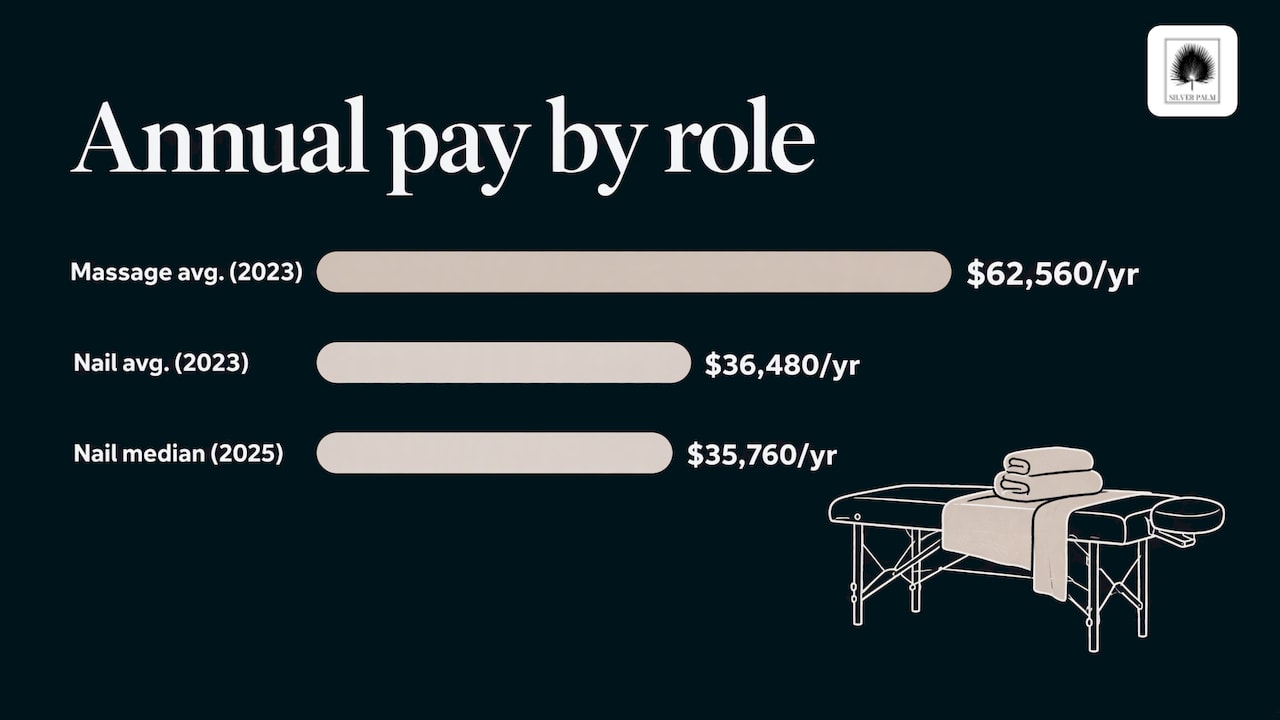
| Massage therapists | About 93,000 employed, average $62,560 per year | May 2023 | BLS |
| Manicurists and pedicurists | About 145,000 employed, average $36,480 per year | May 2023 | BLS |
| Manicurists and pedicurists | Median $35,760 per year ($17.19 per hour), 9% growth outlook | 2025 data, 2025 to 2035 outlook | BLS Occupational Outlook Handbook |
Two things stand out. First, location matters: the BLS found the highest concentrations of massage therapists in Kahului-Wailuku-Lahaina, Hawaii, and Napa, California, both resort and wine-country markets built around spa travel. Second, the nail technician outlook is described by the BLS as much faster than average, which means demand is there if you are building a client book.
Treat any national average as a starting point. Wages are updated by the BLS on a regular schedule, so check the live tables for the latest year before you negotiate. The number that matters most is your own: base pay, commission rate, tips and paid time combined, across a typical week.
Five kinds of spa to work for, compared
Most spa jobs fall into one of five types. The table summarizes how they differ, and the sections below explain who each suits.
| Type of spa | Best for | Typical pay setup | Growth path |
|---|---|---|---|
| Independent luxury salon and spa | Professionals who want a full menu, steady clients and a personal workplace | Varies by role: hourly, commission or a mix, plus tips | Add services, build a loyal client base, move into lead roles |
| Medspa | Estheticians and licensed providers drawn to advanced skin treatments | Often a base plus commission, with clinical oversight | Injectables, microneedling, peels under licensed supervision |
| Franchise massage or facial chain | New graduates who want a steady client flow and a clear system | Often hourly plus per-service pay | Management or trainer roles within the brand |
| Resort or hotel spa | Those who want travel, hospitality benefits and seasonal variety | Hourly or service-based, with tips and sometimes a service charge | Spa director and hospitality management |
| Booth or suite rental | Experienced professionals with their own clients | You pay rent and keep your revenue | Your own brand |
Independent luxury salon and spa: our pick
For a professional who wants variety, an independent luxury salon and spa is the strongest all-round setting. Silver Palm is a luxury salon and spa in Littleton, Colorado, that offers hair cuts, color, highlights and treatments, facials and LED therapy, massage, manicures and pedicures, and medspa services, all in one upscale, relaxing space. We built the experience around personalized attention for each client, which is also how a skilled professional builds a regular clientele: people return to the person who knows them.
That breadth matters for your career. A stylist works near estheticians, massage therapists and nail technicians who share the same clients, so you see how a full-service business runs and which skills you want to add next. You can browse the services we offer on our pages for hair, facials, massage, nails and medspa to see where your skills fit.
Medspa
A medspa combines spa-style services with medical-grade aesthetic treatments. It suits estheticians and licensed providers who want to work with treatments such as microneedling and chemical peels. Roles in this setting depend on the licensing rules in your state, so confirm what your license allows before you apply.
Franchise chains
Franchise spas offer a predictable system, steady bookings and training. They suit people early in their careers who want to build speed and confidence. Because the brand sets the menu and the pricing, you have less say in how services are designed.
Resort and hotel spas
Resort spas draw travelers, which can mean varied clients and seasonal peaks. They suit professionals who value hospitality benefits and are happy with a schedule driven by guest demand. Mountain and destination markets can mean seasonal swings in hours.
Booth and suite rental
Renting a space means you set your own prices and hours and keep the revenue, and you also handle your own marketing, supplies and booking. It works best once you already have a following.
Why spa professionals stay or leave
The most useful research on this question is the Spa Workforce Study from ISPA, the International Spa Association. It surveyed service providers and management in the United States in 2018. Its findings are older, but the priorities it shows are the ones professionals still raise today:
- Pay and benefits were the top reason to stay, cited by 44% of service providers. Culture and work environment followed at 40%, and good relationships with colleagues at 39%.
- Flexible schedules ranked among the top three benefits for 55%, and 50% valued health insurance.
- Management matters: 68% had left a previous role because of poor management.
So a spa with a strong team and a leader who supports you can be worth more than a slightly higher rate somewhere else. If you will be leading others one day, a clear aesthetic staff training plan shows what well-organized onboarding and development look like inside a spa or medspa.
The tips and retail question
The same ISPA study found that only 57% of service providers were satisfied with how their organization handled gratuities, and 46% did not believe upselling retail products should be part of their role, while nearly 90% of managers thought it should be. Fewer than half (46%) agreed their total compensation fairly recognized their contributions.
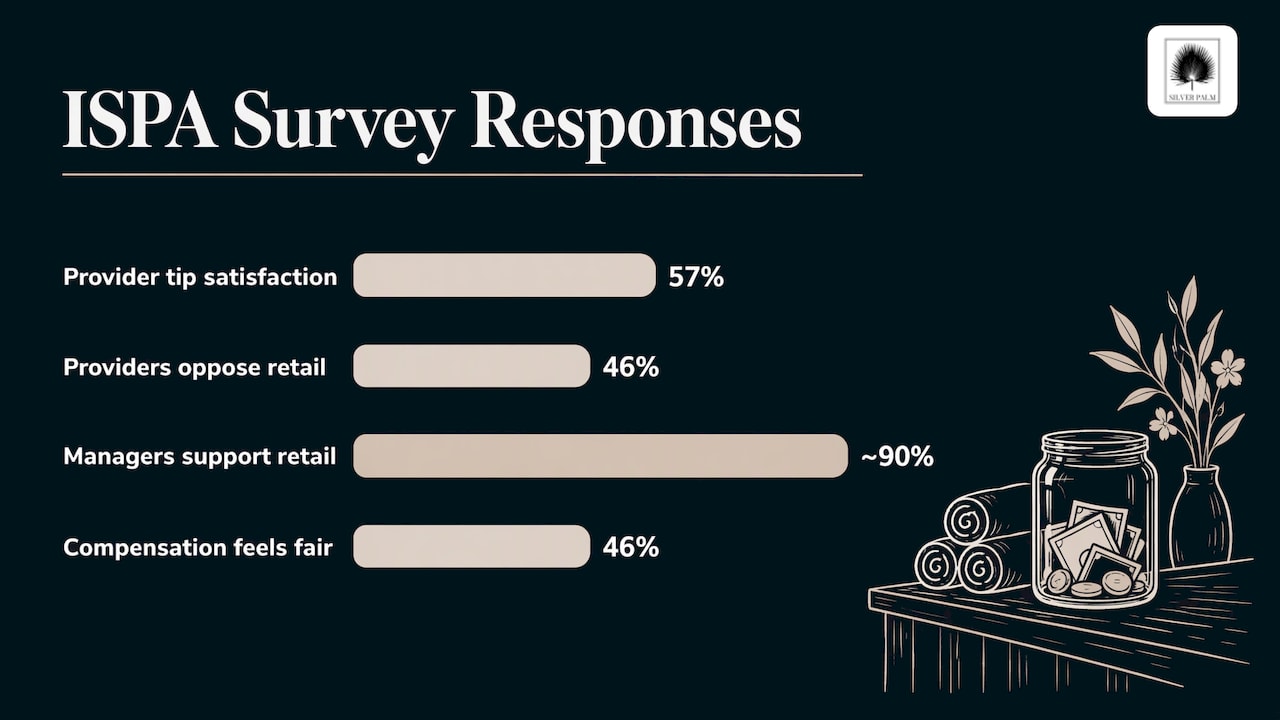
That gap between employees and managers is a reason to ask about retail expectations and tip policy at the interview, not after the first paycheck.
Questions to ask before you accept an offer
Use the list below in every interview, whatever the type of spa.
- How am I paid? Ask whether pay is hourly, commission, or a base with commission, and what is guaranteed in a slow week.
- Is prep and cleaning time paid? Treatment rooms need setup, sanitizing and notes between clients. Massage therapists, for example, sanitize equipment as part of the job according to the BLS.
- How are tips handled? Ask who keeps them and how card tips are paid out.
- Are there retail targets? Find out whether product recommendations are expected and whether they affect your pay.
- What does a full week look like? Ask about evenings, weekends and how many clients you will see in a day, since the BLS notes evening and weekend hours are common for estheticians.
- What benefits and leave are offered? Health insurance, paid time off and flexibility were among the top priorities in the ISPA study.
- Where can I grow? Ask about training, new services and the path to senior or lead roles.
- Will the license I hold cover the work? Most states license massage therapists and many other spa roles. Check your state board’s rules for your license, in Colorado through the state’s Division of Professions and Occupations, before you accept a role that involves new treatments.
Our perspective
We think the best spa to work for is one where the client experience and the team experience come from the same place. A professional who has room to give personalized attention does better work, and clients feel the difference.
That is how we approach Silver Palm. We are a luxury salon and spa in Littleton built around an upscale, relaxing environment and trust with every client. Our menu runs from haircuts, color and highlights to facials, LED therapy, massage, pedicures and medspa services, so the people who work here share a client base and learn from each other’s crafts.
If you are choosing between spas, look for the same things we value: a place that treats every visit as memorable, a menu broad enough to grow into, and a team that wants you to do your best work.
Silver
See where your skills fit
If you live in the Littleton, Lakewood, Morrison or Denver area, start with our full service menu to see how a luxury salon and spa is organized, from hair to massage and medspa treatments. It is the quickest way to judge whether the way we work matches the way you want to work.
FAQ
What does a spa worker do?
A spa worker is anyone who delivers or supports treatments in a spa. That includes massage therapists, estheticians, nail technicians, hair stylists, receptionists and managers. The BLS describes estheticians as cleansing and treating skin, recommending products and teaching skincare routines.
Do I need a degree to work in a spa?
Most spa treatment roles require a state license, earned through a training program and an exam, rather than a college degree. The exact hours and exams depend on the role and the state, so check your state licensing board. The BLS massage therapist page explains the education and licensing path for that role.
Do spa workers keep their tips?
It depends on the spa’s policy. In the ISPA workforce study, only 57% of service providers were satisfied with how their organization handled gratuities, so ask exactly how tips are shared, pooled or paid out before you accept a job.
Is part-time work common in spas?
Yes. The BLS notes that part-time work is common for massage therapists and estheticians, and that estheticians often work evenings and weekends. If you want a set schedule, ask about guaranteed hours when you interview.
Sources
- Massage Therapists, Occupational Outlook Handbook, BLS
- Skincare Specialists, Occupational Outlook Handbook, BLS
- Manicurists and Pedicurists, Occupational Outlook Handbook, BLS
- It’s Self-Care Day: Massage or mani-pedi, anyone?, BLS
- ISPA Spa Workforce Study