Botox explained plainly: what it treats, how the appointment goes, how long it lasts, typical unit pricing, safety facts and how to choose a provider in Littleton.
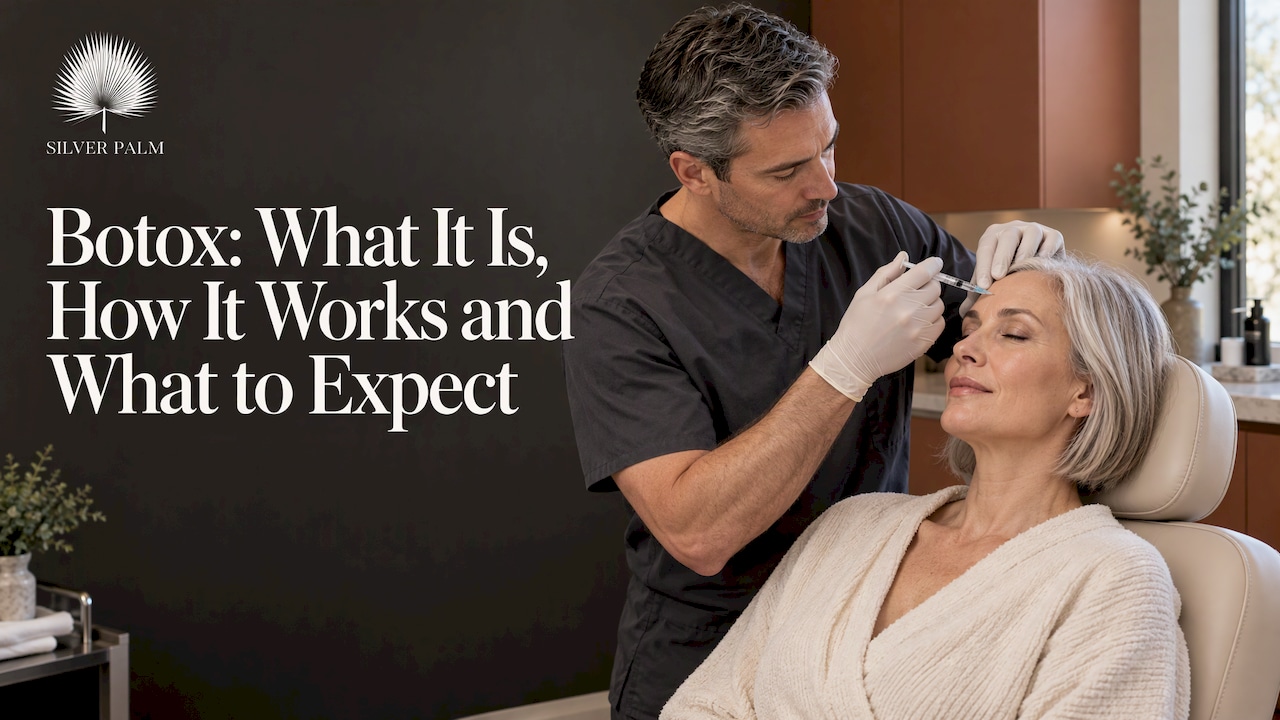
Botox is a prescription medicine, made from a purified form of botulinum toxin type A, that is injected in tiny amounts to relax specific muscles. On the face, that softens the lines those muscles create: frown lines, forehead creases and crow’s feet. Results last about three to four months, and the best outcomes come from a licensed provider who treats the muscles you actually use, not a one-size-fits-all pattern. If you live in or near Littleton, our Botox and neurotoxin services are a calm, upscale place to start that conversation.
This guide covers what Botox is, where it goes, what the appointment feels like, what it costs per unit, the safety facts worth knowing, and how to pick where to go.
Key Takeaways
- Botox temporarily relaxes targeted muscles so the lines above them soften. It does not fill or resurface skin, and effects typically last about 3 to 4 months.
- The FDA-approved cosmetic uses are frown lines between the brows, forehead lines and crow’s feet, and neck bands is also listed for Botox Cosmetic.
- Most people see the first change within a few days, and the full effect takes about two weeks.
- Pricing is usually per unit. A forehead and frown-line treatment commonly uses 20 to 30 units, so the total depends on your anatomy and your goals.
- Botox should only be injected by a licensed medical provider. Pregnancy, breastfeeding and certain neuromuscular conditions are reasons to hold off.
Table of Contents
- What Botox actually is
- How Botox works on lines and wrinkles
- Where Botox is used on the face
- What happens at a Botox appointment
- What Botox costs
- Safety: what you should know before you book
- “Botox in a bottle” and topical products
- How to choose a Botox provider in Littleton
- Our perspective
- Book a consultation in Littleton
- FAQ
- Sources
What Botox actually is
Botox is the brand name for a drug made from botulinum toxin type A. UCSF Health explains that the toxin comes from the bacteria behind botulism food poisoning, yet in very small, medically controlled doses it is safe and effective for smoothing wrinkles in the face and neck and for treating certain medical conditions.
The word “Botox” has become shorthand for the whole category. Other type A products you may hear about include Dysport, Xeomin, Jeuveau and Daxxify, according to the American Society of Plastic Surgeons. They work on the same principle, but they are not interchangeable unit for unit. The prescribing information for Botox Cosmetic states that potency units cannot be converted between botulinum toxin products, which is why you should never compare prices across brands by the unit alone.
Botox also treats medical conditions such as chronic migraine, severe underarm sweating and cervical dystonia, as MedlinePlus describes. This article is about the cosmetic use.
How Botox works on lines and wrinkles
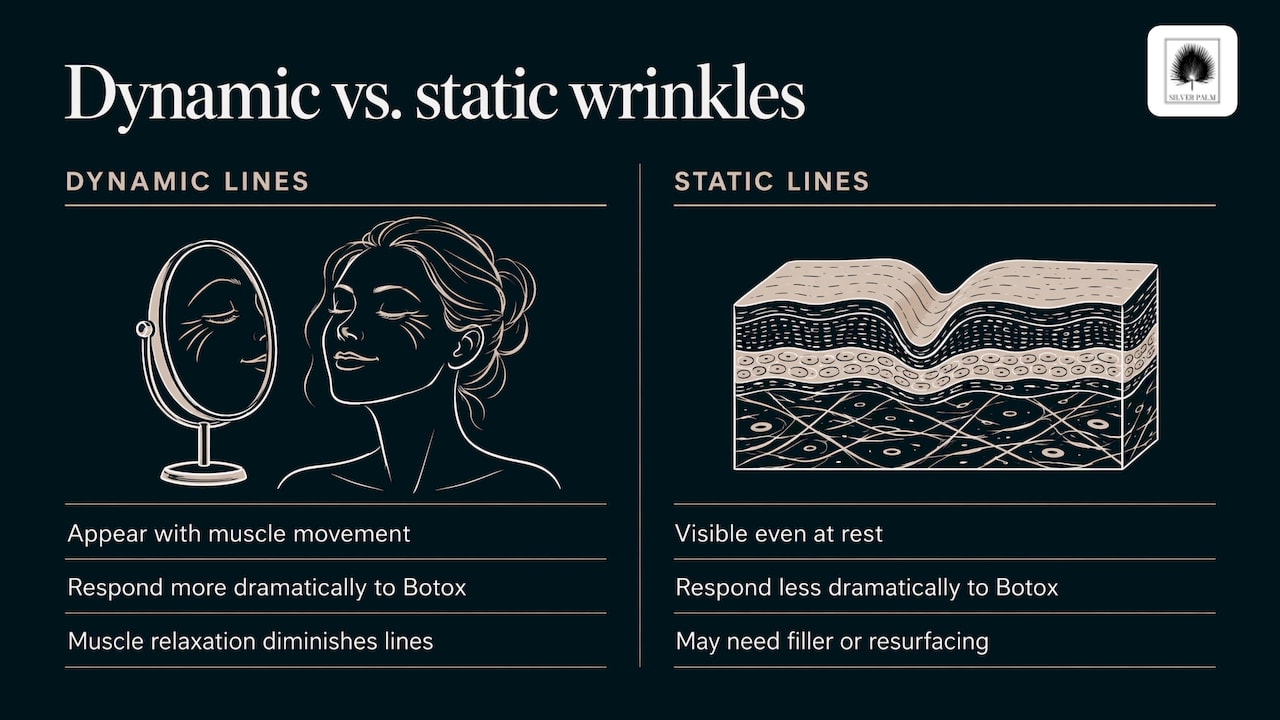
Many facial lines come from repeated muscle movement: squinting, frowning, raising your brows. Botox interrupts the signal that tells a muscle to contract. The American Academy of Dermatology describes it as injecting very small amounts into targeted muscles so they relax and the lines above them diminish.
That explains why Botox works best on what clinicians call dynamic wrinkles, the ones that appear when the muscle moves. The American Family Physician journal (May 2026) notes that dynamic wrinkles respond more dramatically than static wrinkles, which are visible even at rest. If a line is etched in at rest, Botox can still soften it over time, but a filler, resurfacing or a combination may be part of the plan. Our guide to Botox versus fillers walks through how to tell which fits your goal.
A natural result is the aim. The AAD stresses that the goal is just enough toxin to relax the targeted muscles without affecting others, so you keep your normal expressions. A relaxed look, not a frozen one, is what a well-planned treatment delivers.
Where Botox is used on the face
The most common treatment areas are three zones. The American Society of Plastic Surgeons lists frown lines, forehead creases and crow’s feet as the most commonly treated. Yale Medicine describes these as:
- Glabellar lines, the vertical “11s” between the eyebrows.
- Forehead lines, the horizontal creases across the brow.
- Crow’s feet, the lines fanning from the outer corners of the eyes.
The American Academy of Family Physicians notes FDA-approved cosmetic indications for frown lines, forehead lines and crow’s feet, and Drugs.com adds platysma (neck) bands to the approved list for Botox Cosmetic, which may be treated in the same session as the other areas.
Providers also use toxin for other purposes, including lip lines, a gummy smile, chin dimpling, a mouth-corner lift, jawline softening and thick jaw muscles, per the ASPS. Those uses call for an injector with strong anatomical judgment, because small muscles near the mouth affect how you speak and smile.
What happens at a Botox appointment
A typical visit is short. Here is how it usually goes, based on the AAD’s procedure description and UCSF Health’s patient guidance.
- Consultation. You talk through what bothers you, your medical history, medications and any prior treatments. This is where a good provider maps which muscles drive your lines.
- Prep. The skin is cleansed and the injection points are marked.
- Injections. A very fine needle places small amounts of toxin into the chosen muscles. Most people describe quick pinches.
- Aftercare. The AAD advises not rubbing or massaging the treated areas, not pressing makeup into them, and waiting two hours before strenuous activity.
Mild redness, swelling, numbness or small bruises at the injection sites can happen and typically pass, as UCSF Health notes.
When you will see results
You may notice a change 24 to 48 hours after your injections, with final results typically appearing in three to five days, according to UCSF Health. The AFP (May 2026) says the effect takes up to two weeks to fully develop. Plan accordingly if you have an event: schedule at least two weeks ahead so any touch-up can happen before the date.
How long Botox lasts
The AAD says the effect lasts about three to four months and sometimes longer. Cleveland Clinic says treatments are typically repeated every three to six months to maintain results. Muscle activity returns gradually, so lines fade back in slowly rather than all at once. Many people book their next visit when they first notice the movement returning.
What Botox costs
Botox is billed per unit or per treatment area, and, as Drugs.com notes, cosmetic use is generally not covered by insurance. So the price on your quote is units multiplied by the rate.
A useful benchmark comes from Zenoti’s 2026 Beauty and Wellness Benchmark Report, which analyzed 2025 North American data. It put national medspa pricing at about $10 to $12 per unit at the low end of the market, $13 to $15 in the middle and $16 to $20 or more at the premium end. A typical forehead and glabella treatment uses 20 to 30 units, which the report puts at $240 to $540 at $12 to $18 per unit at quality practices.
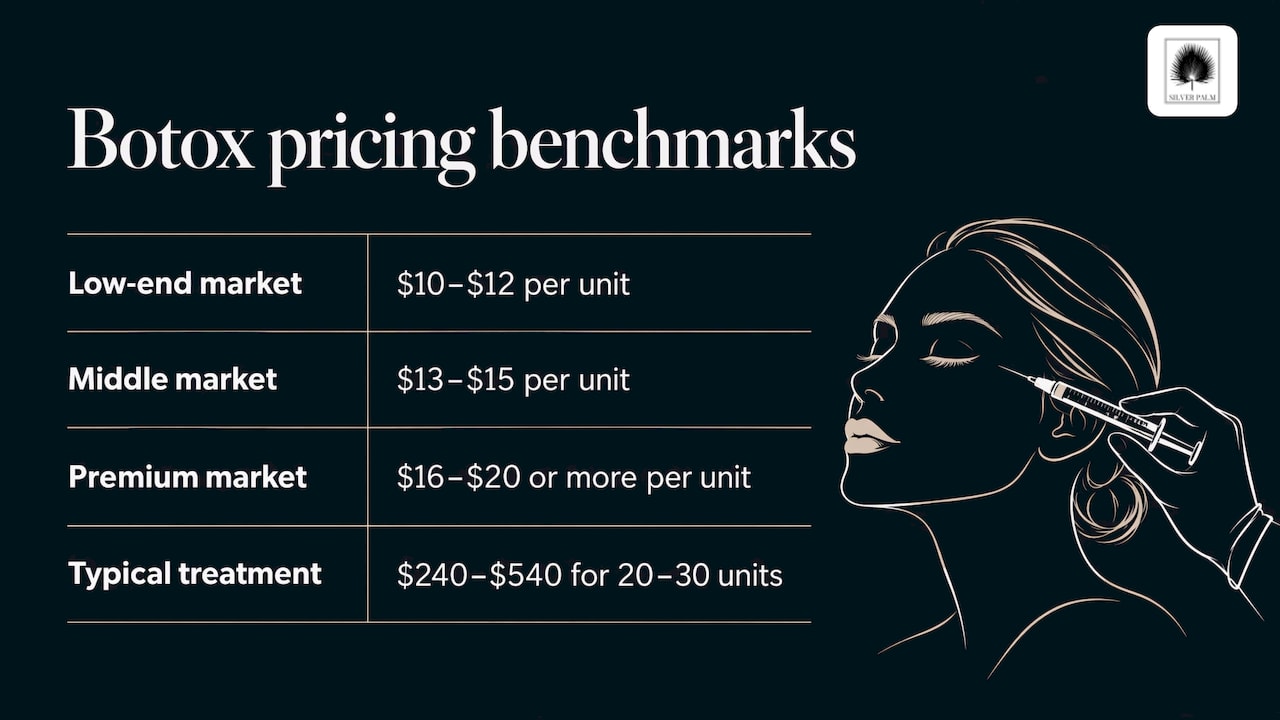
Those figures are national benchmarks from 2025 data, not a Littleton price list, and rates move. The right test for any quote is your own written estimate: the number of units, the areas treated and the per-unit rate.
Why do rates differ? The same report’s pricing strategist argues that a practice charging $10 per unit and one charging $15 are operating in different market segments, with differences reflecting injector experience, facility quality, product authenticity and safety protocols. Those are the things you are paying for beyond the syringe.
Silver Palm does not publish a Botox price online. For a quote, view our medspa services page and reach out about a consultation.
Worked example
Say your provider recommends 24 units across the frown lines and forehead. At the mid-market $13 to $15 range from the benchmark, that is $312 to $360. If you add crow’s feet, the unit count and the total rise. Use this arithmetic to read your own quote, then confirm the rate with the provider.
Safety: what you should know before you book
Botox is generally considered safe when a licensed provider administers it, as Cleveland Clinic states. Knowing the details helps you use it well.
Common side effects
Mayo Clinic lists pain, swelling or bruising at the injection site, headache or flu-like symptoms, droopy eyelids or crooked eyebrows, a crooked smile, and watery or dry eyes. Drooping of the eyelid or brow is technique-dependent, and the AFP notes its incidence declines as injector skill improves.
Who should skip it
Cleveland Clinic and MedlinePlus say Botox should not be used if you are pregnant or breastfeeding. Cleveland Clinic also lists neuromuscular disease and pre-existing drooping eyelids. The AFP adds keloidal scarring, neuromuscular disorders such as myasthenia gravis, and allergy to product ingredients as contraindications. Tell your provider about your full health history and medications at your consultation, and talk with your own physician first if any of these apply to you.
When to get medical care right away
The prescribing information warns that toxin effects can spread beyond the injection site and cause breathing, speech or swallowing difficulties that can be life-threatening. If you have trouble breathing, speaking or swallowing after an injection, seek immediate medical care. Drugs.com also lists generalized weakness, double or blurred vision and hoarseness among symptoms that can appear hours to weeks after treatment.
Where to get it
The AAD is direct: Botox should come from a licensed medical professional, and non-licensed product has caused long-term muscle paralysis, Bell’s palsy and permanent eye damage. It advises against injections at a non-medical spa, party, salon or someone’s home, and against buying toxin online. Mayo Clinic also notes that Botox must be used only under a licensed, skilled provider. A medspa setting with a medical provider is the right category; a pop-up or a home appointment is not.
“Botox in a bottle” and topical products
Creams marketed as “Botox in a bottle” are not Botox. Vogue reports dermatologists saying topicals do not penetrate deeply enough to reach the nerve-muscle connection, and that ingredients like peptides give only a mild, surface-level smoothing. They can be a pleasant part of a skin routine. For a muscle-driven line, injections act on the cause.
If your goals are glow, clarity and hydration, facials suit that job well. Our Signature Custom Facial and DermaSweep Facial are made for that, and many clients pair skin treatments with injectables over time.
How to choose a Botox provider in Littleton
The AFP says clinicians build proficiency through formal instructional courses and precepting with an experienced aesthetic medicine clinician. Since technique drives both your result and your risk of drooping, these are the points that matter when you pick a provider:
- A licensed medical provider performs the injection. This is the safety baseline from the AAD.
- A real consultation. Your provider should look at how your face moves, ask about medications and health history, and explain the plan and the unit count before treating.
- A natural-result philosophy. The goal is movement that looks like yours, softened.
- A clear written quote. Units, areas and per-unit rate in writing.
- A comfortable setting. You are more likely to follow through with maintenance in a place you enjoy visiting.
Our page on Botox and Jeuveau treatments in Littleton goes deeper on what to know before you book.
Our perspective
Most people who ask us about Botox are not chasing a different face. They want to look rested and like themselves, and they want to feel looked after while it happens.
That is how we think about every service at Silver Palm, from a haircut to a facial to a medspa visit. We focus on personalized attention, an upscale and relaxing space, and trust built one visit at a time. Botox fits that approach because it is not a one-time event. It is a rhythm of visits every few months, and a good rhythm starts with a consultation where you are heard.
Because we are a full salon and spa, your Botox plan can sit alongside the rest of your self-care: a facial to keep skin bright, a fresh cut and color, a massage afterward. Treating the whole routine in one place is how our clients keep results looking consistent and natural.
Silver
Book a consultation in Littleton
Silver Palm is a luxury salon and spa in Littleton, Colorado, and our medspa menu includes Botox and neurotoxins, dermal fillers, microneedling, chemical peels and more. If you are weighing your first treatment or returning for maintenance, see the Silver Palm medspa page to learn what we offer and to book.
FAQ
How long does Botox take to work?
You may notice a change within 24 to 48 hours, and final results usually settle in three to five days, per UCSF Health. The full effect can take up to two weeks. Booking a few weeks before an event leaves room for a touch-up.
How often do I need Botox?
Results last about three to four months, and Cleveland Clinic says treatments are typically repeated every three to six months. Your provider can suggest a schedule based on how your muscles respond. Over time, some people find their results last longer.
Does Botox hurt?
The injections use a very fine needle and are quick. Most people feel brief pinches, and mild redness, swelling or small bruises at the sites are possible afterward, as UCSF Health describes. Follow your provider’s aftercare steps, such as avoiding rubbing the area and waiting two hours before strenuous exercise.
Is Botox the same as filler?
No. Botox relaxes muscles to soften movement lines, while fillers add volume. Each addresses a different cause of aging in the face, and some people use both. Our comparison of Botox and fillers helps you decide what matches your goals.
Who should not get Botox?
Cleveland Clinic and MedlinePlus advise against it during pregnancy or breastfeeding, and Cleveland Clinic also lists neuromuscular disease and pre-existing drooping eyelids. The AFP adds keloidal scarring and allergy to product ingredients. Share your complete health history with your provider before treatment.
Sources
- Cosmetic Botox, UCSF Health
- Botox and Soft Tissue Fillers, Yale Medicine
- Botulinum Toxin Procedures, American Family Physician (May 2026)
- Botox (Botulinum Toxin), Cleveland Clinic
- Botulinum Toxin, American Society of Plastic Surgeons
- Botulinum toxin therapy FAQs, American Academy of Dermatology
- Botox, MedlinePlus
- Botox injections, Mayo Clinic
- Botox: Uses, Dosage, Side Effects, Drugs.com
- How to Price Med Spa Services, Zenoti
- Best Botox in a Bottle Skin-Care Products, Vogue