What hair stylist jobs involve, how licensing works in Colorado, what stylists earn per BLS data, and how to judge a salon, whether you work in one or book one.

A hair stylist job is a licensed, client-facing craft career. Most stylists work in salons, spas or barbershops, and the day is built around consultations, cuts, color and styling. The work needs a state license, and pay depends on where you work and how you are paid. Colorado licenses stylists through a state office, so you check there first. Below is what the job involves, how the pay arrangements work, and how to read a salon, whether you want to work in one or are choosing who to trust with your hair in Littleton.
Key Takeaways
- Stylists consult, cut, color, treat and style hair, then handle payment and sanitation. The job is as much about listening as it is about technique.
- The standard route is a state-approved program followed by a licensing exam. In Colorado the licensing body is the Office of Barber and Cosmetology Licensure.
- The U.S. median wage for hairdressers, hairstylists and cosmetologists was $17.21 an hour in 2025 by O*NET’s figures, and pay varies by city, pay structure and clientele.
- Salon setting matters as much as the job title. Ambiance, service range, and how much one-on-one attention a stylist can give shape both a career and a client’s visit.
- If you are looking for a stylist rather than a job, the same qualities that make a good workplace make a good salon to book.
Table of Contents
- What a hair stylist does all day
- The different roles in a salon
- Where stylists work
- How hair stylists get licensed in Colorado
- What hair stylists earn
- Outlook: growth, and what about AI?
- Schedules and the realities of the job
- How to evaluate a salon as a place to work
- If you are really looking for a stylist
- Our view: what makes a salon worth your time
- Book a visit with us in Littleton
- FAQ
- Sources
What a hair stylist does all day
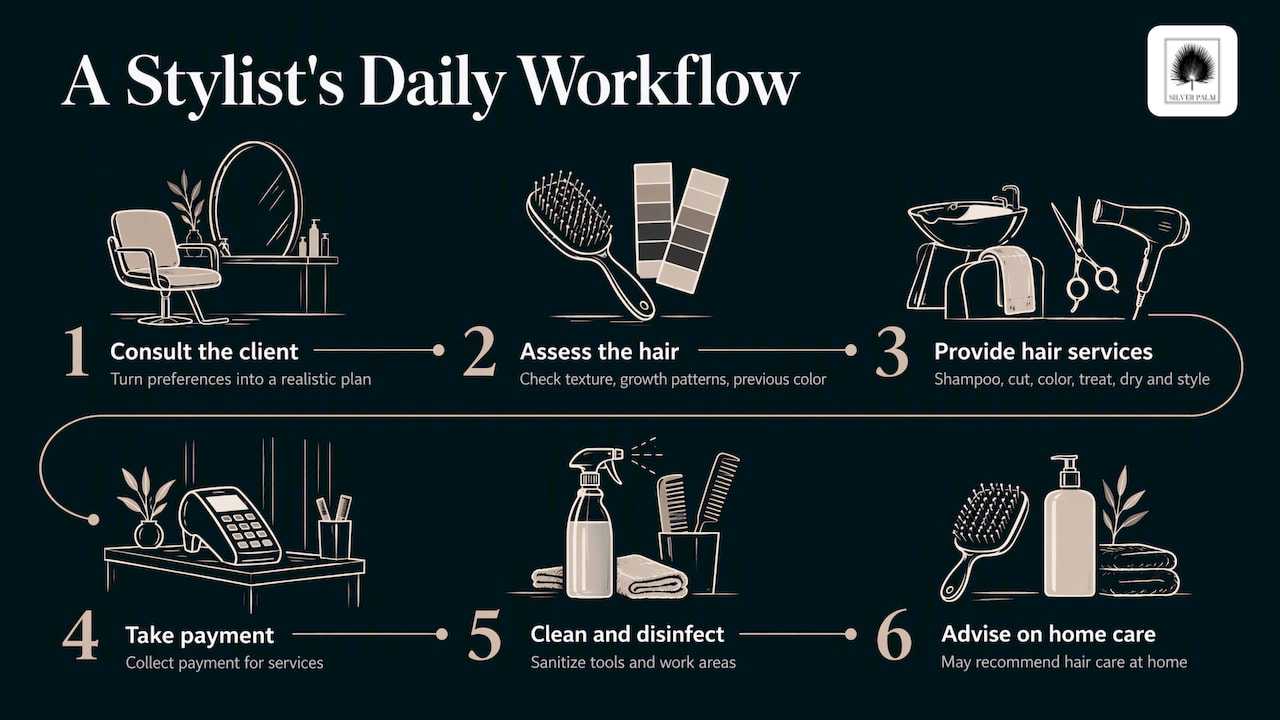
The Bureau of Labor Statistics describes the daily work as consulting with clients, analyzing hair, scalp and skin, then shampooing, cutting, coloring, lightening, conditioning, chemically treating, drying and styling hair. Stylists also take payment and clean and disinfect their tools and work areas. They may advise clients on how to care for their hair at home.
That list hides the part clients feel most: the first five minutes. A good consultation turns “a little shorter, but not too short” into a plan. The stylist looks at texture, growth patterns, previous color and how the client actually styles their hair on a Tuesday morning. Then the stylist decides what is realistic.
O*NET, the federal occupational database, adds scalp treatment, makeup, wig dressing and hair removal to the picture. Some stylists also offer nail or skin-care services. In a full-service salon and spa, that range of services is what lets one stylist be part of a client’s regular routine instead of a once-a-year haircut.
BLS names the qualities that matter most: customer-service and listening skills, physical stamina, tidiness and time management. Stylists stand for most of the day, and a schedule only works when each appointment starts and ends on time.
The different roles in a salon
People searching for stylist jobs often mean several different roles. Here is how they usually break down.
| Role | What it involves |
|---|---|
| Hair stylist | Cuts, color, highlights, styling and treatments for a personal client list |
| Colorist | Focuses on color services such as all-over color, partial highlights and balayage |
| Barber | Men’s cuts, fades and shaves, often licensed separately from cosmetologists |
| Esthetician | Facials and skin treatments, with a separate license track |
| Nail technician | Manicures and pedicures |
| Massage therapist | Massage services in a spa setting |
| Front desk or salon coordinator | Booking, check-in and client communication |
| Salon manager or owner | Hiring, supervising staff, keeping records, ordering supplies and arranging advertising |
BLS notes that owners may hire and supervise staff, keep records, order supplies and arrange advertising, which is why many stylists treat ownership as a later step rather than a starting point.
Salon staff are most often just called stylists, colorists or technicians, depending on specialty. In a salon with a spa side, you will also hear estheticians and nail techs mentioned by service name.
Where stylists work
Per BLS, stylists mainly work in salons or barbershops, while some work in spas, hotels or resorts. Some lease booth space, manage salons or open their own shop.
Those settings feel very different day to day:
- Independent or boutique salons keep the client list small and personal. Stylists get to know regulars well, and the work leans on relationships.
- Spa and salon combinations let a stylist work alongside estheticians, massage therapists and medspa providers, so clients can book a haircut and a facial in one trip.
- Hotels and resorts bring a steady stream of one-time guests and event styling.
- Booth rental means running your own small business inside someone else’s building: your own pricing, your own supplies, your own taxes.
If you are weighing workplaces, our guide on how stylists compare their options walks through the factors that matter beyond the commission split.
How hair stylists get licensed in Colorado
The usual route nationwide, per BLS, is a state-approved barber or cosmetology program that combines classroom and hands-on training, followed by a licensing exam. States generally set minimum age and education requirements, require graduation from a state-licensed school, and test with a written exam and sometimes a practical or oral one. Fees, renewal, continuing education and reciprocity (whether one state honors another’s license) all vary by state.
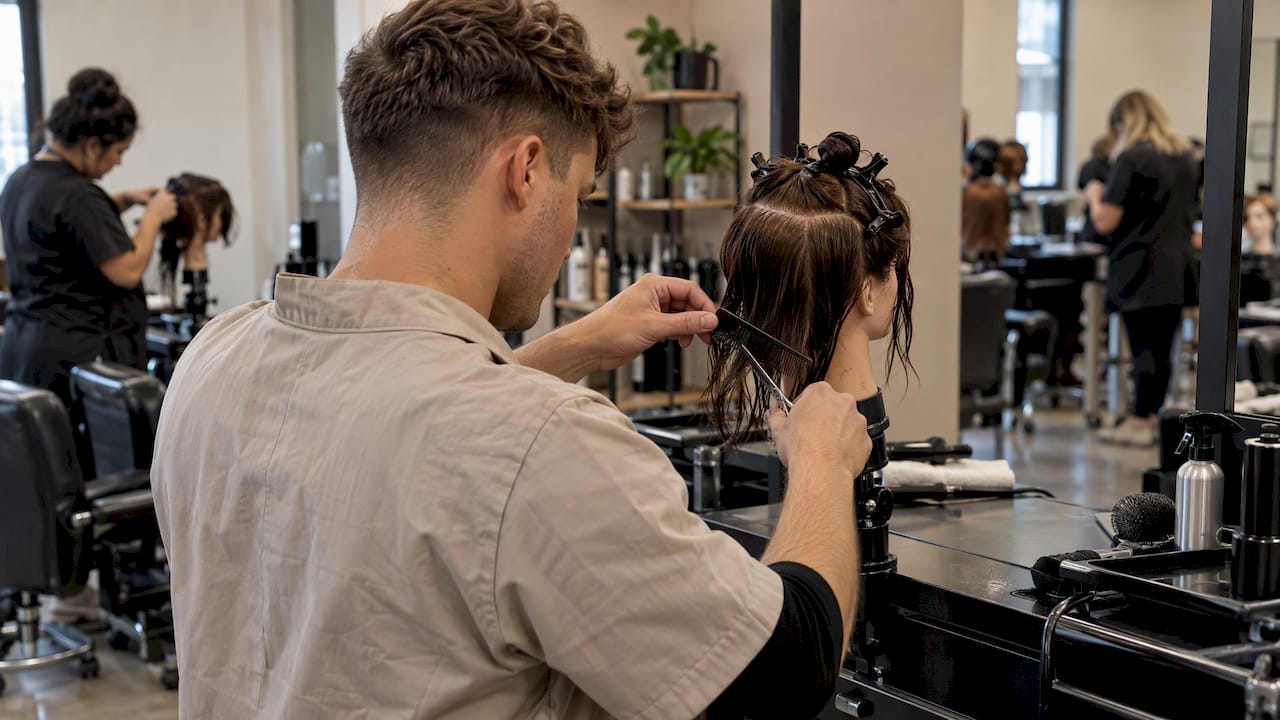
In Colorado, those rules sit with the Department of Regulatory Agencies’ Office of Barber and Cosmetology Licensure. The state’s published rules set minimum training by license type, with separate requirements for hairstylists and cosmetologists, and list the subject areas a school must cover, such as haircutting, hairstyling, chemical services, coloring and law and safety.
Training hours, exam fees and compact or reciprocity arrangements are the details that change, so confirm them on the DORA licensing page before you enroll in a school or apply for a license. Do not rely on a third-party summary, because a requirement that was current when the page was written may have been revised since.
A license is what lets you take a paid chair legally. It also matters to clients: a licensed stylist has trained on color chemistry, sanitation and skin and scalp safety, which is exactly what you want when someone is lightening your hair.
What hair stylists earn
BLS’s May 2023 wage data counted 294,840 workers in the narrower hairdressers, hairstylists and cosmetologists category. It reported a median of $16.81 an hour ($34,970 a year) and a mean of $20.09 an hour ($41,780 a year). The mean sits above the median because top earners pull it up.
O*NET’s current profile shows a 2025 median of $17.21 an hour, or $35,790 a year, for 595,000 employees. These are national figures, published on a schedule by federal agencies, and they update with each new release. They are a starting point, not a promise for any salon.
The job-board listings that rank for this search show wide hourly ranges from city to city, and the spread tells you something real: pay is not one number. What moves it:
- Pay structure. Hourly, commission, a mix, or booth rent each change what you take home. Tips are part of the income picture in most chairs.
- Service mix. Color services such as balayage and partial highlights take longer and carry higher prices than a standard cut, so a stylist with strong color skills can earn more per hour.
- Client list. A full book of regulars is the most reliable income driver, and it takes time to build.
- Location and clientele. A salon in an area where clients expect upscale services supports higher service prices.
- Add-on skills. Treatments, extensions and smoothing services give a stylist more to offer each client.
To see how service prices work in practice, look at what a salon publishes. At Silver Palm, haircuts start at $75 for women and $50 for men, a full balayage starts at $200, all-over color starts at $120, and partial highlights start at $150. Those are starting prices, and the final price depends on the client’s hair and the work involved. A stylist’s earning potential grows with how many of those higher-value services they are trained to do well.
Outlook: growth, and what about AI?
O*NET projects growth of at least 7 percent for hairdressers, hairstylists and cosmetologists from 2025 to 2035, with 73,400 projected openings. Many of those openings come from workers who leave the field or retire, so a well-trained stylist has real room to find a chair.
A common question is whether AI will replace hairdressers. Software can suggest a style or simulate a color on a photo. The job itself is physical, personal and done in the room with the client: reading the hair, adjusting in the moment, and making someone feel looked after. The qualities BLS lists, listening and customer service among them, are the ones that stay human.
Schedules and the realities of the job
BLS reports that most workers are full time and part-time work is common. Schedules often include evenings and weekends, because that is when clients are free. Self-employed owners may work long days but control their own schedules.
Three practical points are worth knowing before you commit:
- Stamina is real. Standing and working with your arms raised for hours is physical, which is why BLS lists it among the important qualities.
- Time management is a skill. Color services have processing times, and good stylists use those minutes to keep the next client on schedule.
- Tidiness is part of the work. Sanitizing tools and keeping the station clean is on the BLS task list, and clients notice.
How to evaluate a salon as a place to work
Whether you are a new graduate or an experienced stylist, ask the same questions:
- What does the service menu look like? A broad menu, such as cuts, color, treatments, extensions and smoothing, gives you more ways to grow.
- How is pay structured? Get hourly, commission or rental terms in writing.
- How does the team work together? A salon where hair, skin and spa providers refer clients to each other builds your book faster.
- Is the environment one you want to spend your days in? Ambiance matters. A calm, well-kept space affects your mood and your clients’ experience.
- What do clients say? Reviews are an honest read on service quality and consistency.
If you are really looking for a stylist
Many people who type “hair stylist jobs” are curious about the profession because they want to understand who is behind the chair. That is a good instinct. What a stylist does, how they were trained and how they work with you all shape the result.
Here is what to look for when you book:
- A real consultation. The stylist should ask about your routine, your hair history and what you want before touching a pair of scissors.
- A licensed professional. Colorado licenses stylists, so you can expect the person working on you to hold one.
- A range of skills in one place. If you need a cut, color and a conditioning treatment, a salon that offers all three lets one team coordinate the plan.
- Prices that start clear. Published starting prices let you plan before you arrive.
Our pages on choosing a hair salon in Littleton and on what a haircut and blowout includes cover these questions in detail.
Our view: what makes a salon worth your time
We think the best salons are built around attention. Our approach at Silver Palm is personalized service in an upscale, relaxing space, and we design every visit to feel memorable and satisfying.
A salon day should not be rushed. When a stylist can focus on one person, the consultation is more thorough, the color is more considered and the finish is more polished. We offer cuts, color, highlights, balayage, deep conditioning, Olaplex bond repair and keratin smoothing treatments, so clients can build a complete hair plan in one place.
The same idea extends past hair. Facials, LED therapy, massage, nails and medspa services share our Littleton space, and that lets clients treat a visit as self-care, not just an errand.
Trust is built one appointment at a time, and our reviews reflect the results our clients see. That is the standard we hold ourselves to.
Silver
Book a visit with us in Littleton
If you want to see the craft up close, our hair services page lists haircuts, color, highlights, balayage, deep conditioning and extensions, with starting prices where published. A women’s haircut starts at $75 and a men’s haircut starts at $50. For smoother, stronger hair, our hair treatments include Olaplex bond repair and keratin smoothing.
FAQ
What is the job description of a hair stylist?
A hair stylist consults with clients, analyzes hair and scalp, and then cuts, colors, conditions, chemically treats and styles hair. They also take payment and keep tools and work areas clean and disinfected, per BLS. Many also advise clients on at-home hair care.
Will AI replace hairdressers?
The work is hands-on and personal, and listening and customer service are among the top qualities BLS lists for the job. O*NET projects growth of at least 7 percent from 2025 to 2035. Technology can preview a look, but it cannot cut or color hair.
What do you call salon staff?
Most are called stylists, colorists or hair technicians. Specialists have their own titles: barbers, estheticians, nail technicians and massage therapists. Owners and managers run the business side.
Do you need a license to be a hair stylist in Colorado?
Yes. Colorado licenses hairstylists and cosmetologists through the Office of Barber and Cosmetology Licensure under the state’s published rules. Check the DORA site for current hours, fees and exam details before you enroll.
Sources
- Barbers, Hairstylists, and Cosmetologists: Occupational Outlook Handbook, BLS
- Hairdressers, Hairstylists, and Cosmetologists, May 2023 wage data, BLS
- 39-5012.00 Hairdressers, Hairstylists, and Cosmetologists, O*NET OnLine
- Office of Barber and Cosmetology Licensure rules, 4 CCR 731-1, Colorado Secretary of State